April 16, 2026
Updated on
August 31, 2026
Empathy workshops: Understanding the user perspective
Your product team is planning the next big feature. Everyone is motivated, everyone has ideas, the product owner has already sketched out three possible solutions. Development estimates the effort, Design delivers the first wireframes. Everything is running smoothly. Only one question has not been asked: what does the user actually need?



Table of contents
That sounds banal. But it is not. Teams surprisingly often build on the basis of assumptions rather than real understanding. And these assumptions are expensive. They manifest themselves in features that are barely used. In support requests that better onboarding would have made superfluous. In conversion rates that stagnate despite a technically sound product. The error rarely lies in the implementation - it lies in the lack of access to the user perspective.
As part of our series on the five most important UX workshop formats, this article is dedicated to the Empathy Workshop, which helps teams to gain this access.
We explain how an Empathy Workshop is structured, which methods are used and when it is really worthwhile. We take a look at the empathy map as a central tool, go through the typical process step by step and also identify common situations in which a different format would make more sense.
What is an empathy workshop?
An empathy workshop is a collaborative format in which interdisciplinary participants (designers, product managers, stakeholders, sometimes also developers) work together to try to adopt the perspective of a real or typified user.
The aim is not to generate empathy in the sense of sympathy. Instead, it is about gaining a deep understanding of the needs of users or individual user groups. The idea behind this is very simple: if you understand why a user breaks off at a certain point, you can also find a better solution to the problem.
In practice, the format sits inside a wider UX strategy rather than alongside it.
Differentiation from the Discovery Workshop
While a Discovery Workshop clarifies the project framework (business goals, stakeholder expectations, technical framework conditions), the Empathy Workshop zooms in on the emotional experience of the user and thus finds out which user needs must be addressed in order to achieve the defined business goals.
The two formats complement each other perfectly, but cannot replace each other.
Differentiation from personas and user research
An empathy workshop can combine individual existing findings and anchor them in the team. Or serve as an efficient introduction when the team starts to deal with a new target group. However, it is no substitute for in-depth user research. It does not replace interviews, field studies or quantitative analyses.
Observed behaviour only comes out of usability testing; the workshop condenses what was found there.
A direct classification is important at this point: if neither interviews nor support evaluations or analytics data are available, then the Empathy Workshop is based purely on assumptions. This can still be valuable for formulating hypotheses and making knowledge gaps visible, but should be communicated transparently. As long as the result is not confused with validated knowledge, an empathy workshop based on gut feeling is still better than no change of perspective at all.
The empathy map: The heart of the workshop
The Empathy Map is the central tool in the Empathy Workshop. It structures the user's perspective in four quadrants:
Says what users express verbatim in interviews, support tickets or feedback forms. Example from a B2B SaaS context: "I don't understand where I can set usage rights for team members."
Thinks goes deeper. This is where the thoughts that users don't say out loud, but which nevertheless influence their behavior, end up. For example: "Why isn't this working for me?" - a thought that users silently carry with them as they close the tab and never open it again.
Does documents observable behavior. What workarounds do people use? Where do they click three times, where once? Example: A user exports data to Excel, edits it there and imports it back because the built-in editing function is too cumbersome.
Feels records the emotional state. Frustration, uncertainty, relief, overwhelm. Example: Annoyed because every change to the settings triggers a confirmation workflow with three approval levels.
Optionally, the map can be supplemented by two further areas: Pains bundles specific pain points that result from the four quadrants.Gains captures the state that the user actually wants. This extension is particularly helpful if the workshop is to move directly into idea development.
Anyone who wants to map those emotions along a concrete flow combines the empathy map with user journey mapping. We also run that as a facilitated User Journey Mapping Workshop.
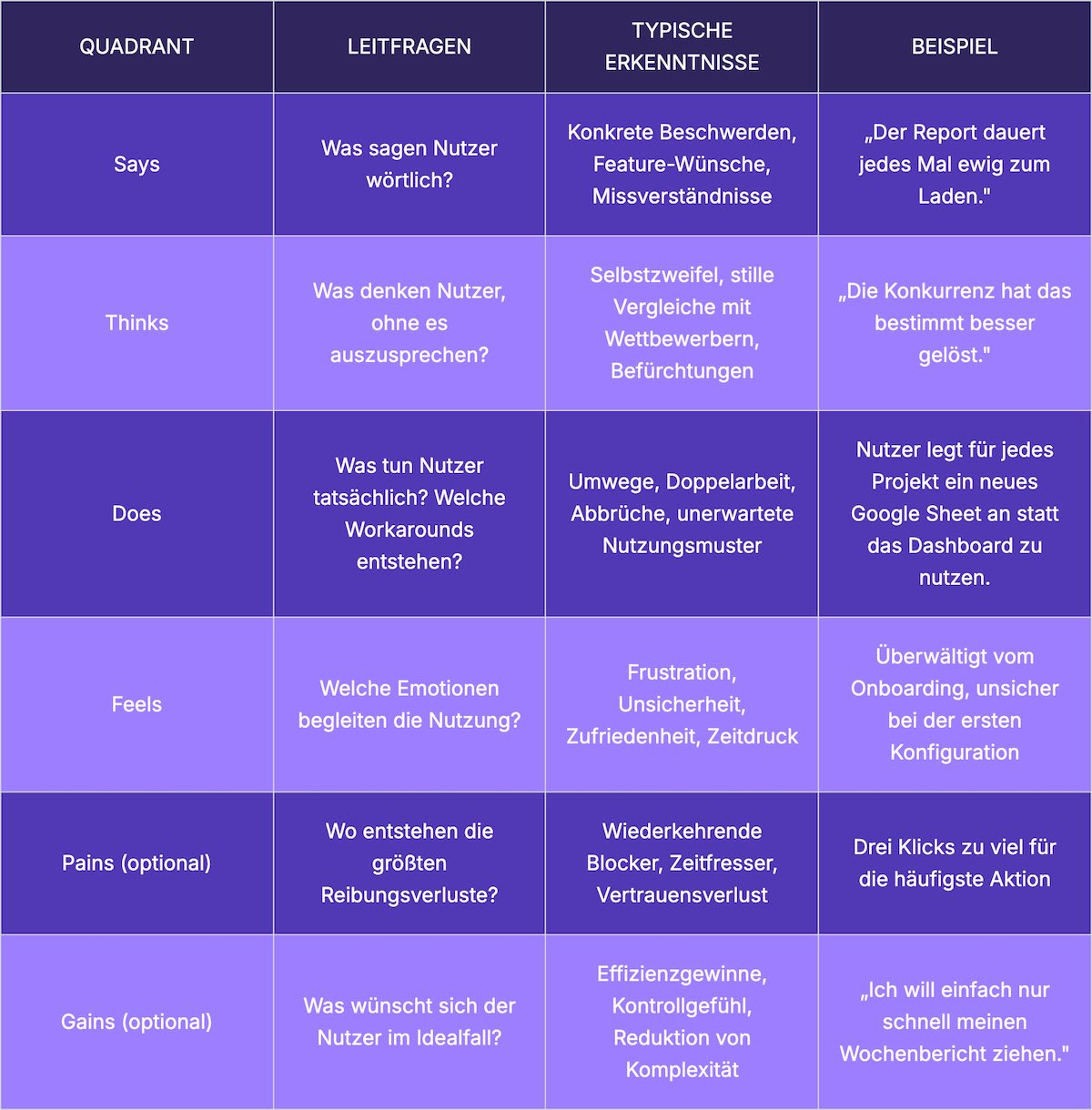
As already mentioned, empathy maps based on real interview findings work much better than purely hypothetical maps. If the team can draw on real quotes and observed behavior, the quadrants become more concrete, the discussions sharper and the findings more robust. Hypothetical maps still have their place by making assumptions tangible and showing where the team agrees and disagrees.
Empathy workshop process: how a session works
The process of an empathy workshop follows a clear structure: four phases that build on each other.
Phase 0: Preparation
Before the workshop begins, you need a defined user profile or a persona that the team will focus on. Existing interview transcripts, support evaluations or analytics data should be prepared. You will also need a whiteboard tool such as Miro or FigJam (or a physical whiteboard with sufficient sticky notes). Take enough time to create the best possible basis for the workshop: Preparation massively determines the quality of the results.
Phase 1 - Getting started and setting the context
Explain the aim of the workshop, introduce the relevant user scenario and bring all participants up to the same level of knowledge. This is also where the rules of the game are explained: the next phase is not about discussing, but collecting. If you skip this phase, you will spend the rest of the workshop clearing up misunderstandings.
Phase 2 - Individual filling of the empathy map
Each participant enters their assessments in the four quadrants - silently, for themselves, without coordinating with others. Quantity before quality. The aim is to bring as many perspectives to the table as possible, not to find the perfect formulation. If you are already discussing at this stage, you are missing the point. The strength lies precisely in the uncensored juxtaposition of different points of view.
Phase 3 - Clustering, discussing, prioritizing
Now it gets exciting. The team sifts through the collected contributions together, identifies commonalities and identifies contradictions. Where does everyone agree? Where do the assessments diverge? It is precisely these differences that are worth their weight in gold, as they are clear proof that the team still knows too little about its users. Pain points and so-called moments of truth are marked and prioritized.
Phase 4 - Documenting findings and determining next steps
The workshop does not end with a full empathy map, but with three questions that point the way forward:
- What do we take away? What insights will change our understanding of the user?
- What assumptions need to be validated? Where do we need real data instead of hypotheses?
- What design decisions can be made now? What can we implement immediately without waiting for further research?
If the findings feed straight into solution ideas, the Design Studio Workshop is the natural next step.
4 situations for empathy workshops
An empathy workshop unfolds its greatest leverage at very specific moments in the product process.
But: If your team has not yet had any user contact - no interviews, no observations, no evaluated support data - then you should prioritize user research first. The Empathy Workshop should consolidate findings. If there are no insights yet, nothing can be consolidated.
Product relaunch
If an existing product is to be rethought, the workshop helps to uncover blind spots in user understanding. Teams that have been working on the same product for years often develop a kind of operational blindness - they no longer see what new or less experienced users experience on a daily basis. The workshop forces the team to consciously shed this filter.
New features
Before a feature is specified, it is worth changing your perspective. Anyone who understands how users feel in the situation in question will build better solutions than someone who only looks at metrics. This sounds obvious, but in practice it rarely is.
High support volume
If the same questions end up in support again and again, there is often a UX problem behind it that no one has recognized as such. The Empathy Workshop makes visible where the friction arises and why users don't find what they are looking for. Just how heavily these repeat questions weigh on the budget is set out in our breakdown of the costs of bad UX.
Preparing for user interviews
Sounds paradoxical, but it works: an Empathy Workshop before the interviews helps the team to formulate better questions. Because your own assumptions are explicitly on the table, the right gaps can be specifically addressed. Good interviews start with knowing what you don't yet know.
In the design process, the workshop is best used after initial user interviews or at the start of a discovery phase to gather existing knowledge. It is less suitable as a final measure, as it inherently raises questions rather than answering them.
Once the pain points are ranked, a Prioritization Workshop typically follows.
Who should take part in the Empathy Workshop
The workshop is most effective when it's not just designers and researchers in the room. Product owners, stakeholders and developers bring different perspectives to the table. And that's exactly the point! If only the UX department fills in the empathy map, the effect that makes the workshop so valuable is missing: a shared understanding across team boundaries.
Conclusion
Teams that ask the right questions and really understand their users build better products.
If you are considering an Empathy Workshop, you should think about it in combination with a Discovery Workshop. The Discovery Workshop clarifies the goal, the Empathy Workshop clarifies the path. Together, they form a solid foundation for user-centered product development.
If the research data is missing, we take over recruiting and moderation in usability testing.
Want to find out which workshop format provides the most leverage for your team? Book a free initial consultation with our founder Victoria and together we will clarify where you stand and what the most sensible next step is.
Empathy Workshop FAQ
What is an empathy workshop?
An Empathy Workshop is a collaborative team format in which designers, product managers, stakeholders, and developers work together to adopt a user’s perspective. It is not merely a research tool, but a workshop that brings existing knowledge about users to light and embeds it within the team. The central tool is the Empathy Map, which structures the user experience into four areas.
What is an empathy map, and how do you fill it out?
The Empathy Map divides the user's perspective into four quadrants: Says (what users say), Thinks (what they think), Does (what they do), and Feels (what they feel). Each participant first fills out the quadrants individually before the team collaboratively clusters and prioritizes the results. Optionally, the “Pains” and “Gains” sections can be added to explicitly capture pain points and desires.
How long does an empathy workshop last?
A typical Empathy Workshop lasts between half a day and a full day. The exact duration depends on the team size, the available data, and the depth of the subsequent discussion. For a focused team that is well-prepared, three to four hours are often sufficient—but for more complex scenarios or larger groups, a full day may be appropriate.
What is the difference between an Empathy Workshop and a Discovery Workshop?
The Empathy Workshop focuses on understanding users—what they experience, think, and feel. The Discovery Workshop clarifies the project scope: business objectives, stakeholder expectations, and technical requirements. Both formats complement each other and are ideally used in combination, but they are not interchangeable.
When doesn't a product team need an empathy workshop?
If there is no user data available and no user research is planned, the workshop will only yield hypotheses—not insights. In this case, the priority should be on user research: conducting interviews, reviewing support tickets, and analyzing usage patterns. The Empathy Workshop truly comes into its own as a synthesis tool, not as a substitute for direct contact with users.