May 5, 2026
Updated on
August 31, 2026
Design Studio Workshop: Method, process & tips for UX teams
"Who has ideas for the new booking flow?"


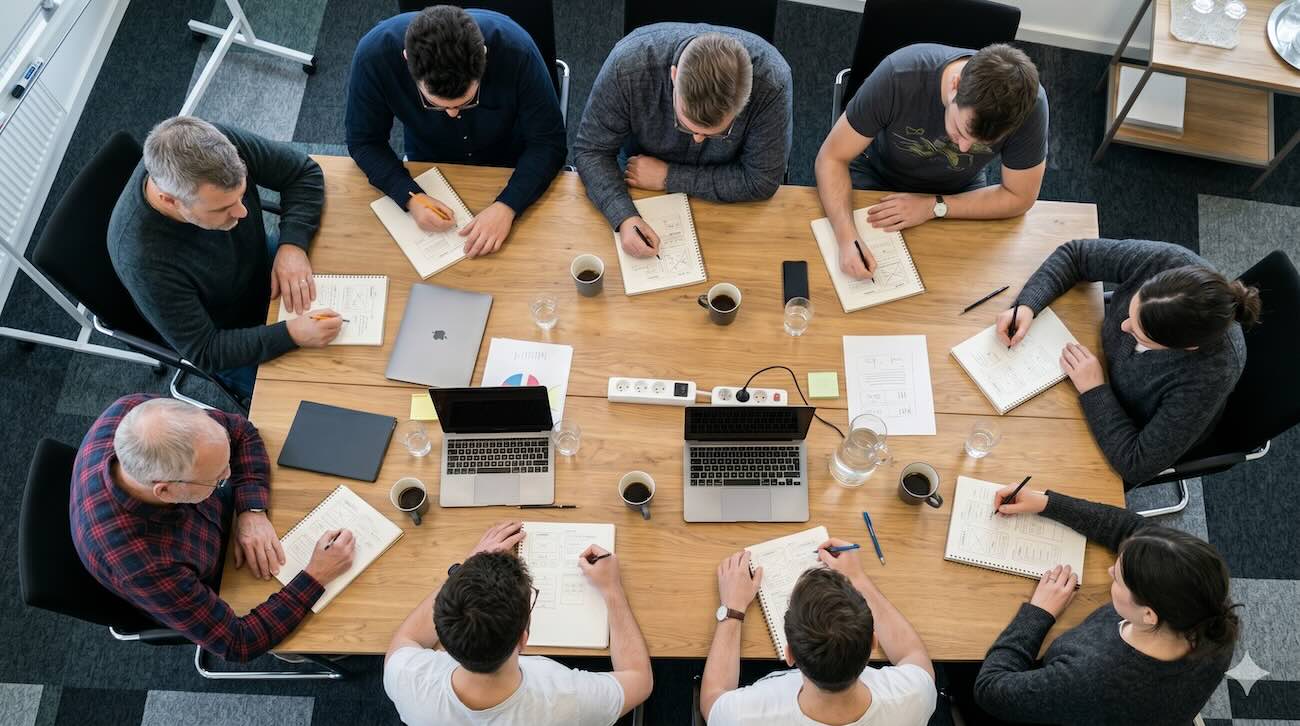
Table of contents
Imagine a typical situation in the product team: The research team has spent three weeks conducting user interviews. Everything is neatly prepared, the personas are hanging on the wall, the pain points are clearly documented. Then someone sends a Slack message:
"Who has ideas for the new booking flow?"
Two weeks of asynchronous discussions, three meetings without results and a Figma file in which exactly one person has thrown screens (without the rest of the team knowing why) follow.
A design studio workshop closes precisely this gap between research findings and initial solution approaches. The format brings an interdisciplinary team together to sketch, present and constructively criticize ideas under time pressure. A design studio is one of the 5 most important UX workshop formats, in which divergent and convergent thinking are combined: It allows teams to explore a wide range of ideas in a short space of time while developing a shared vision.
The most important things at a glance
For those who are short on time, here are the key points:
- Divergent meets convergent - Design Studio workshops combine quick sketching (generating lots of ideas) with structured critique (filtering the strongest ideas) in a compact session.
- Clearly defined problem as a prerequisite - The format is most effective when there is a common understanding of the problem and an interdisciplinary team needs to find solutions quickly.
- No drawing talent required - Anyone in the room can take part. Rectangles, arrows and lines are enough. What counts is the ability to communicate an idea visually.
- Directly connectable - The Design Studio Workshop connects seamlessly with the Empathy Workshop (as an input provider) and Critique sessions (as an output taker).
Result: prioritized sketches, no final design - The result is deliberately not a finished screen. It is a prioritized collection of sketches that serves as the basis for the next prototyping sprint.
What is a Design Studio Workshop?
The Design Studio Method is a collaborative sketching workshop in which interdisciplinary team members generate, present, critique and iterate on design solutions in quick, stopped rounds. In essence, it is about repeating three activities in several short iterations: sketching, presenting and critiquing. The goal is a broad range of ideas plus a jointly prioritized direction that the team can continue working with after the workshop.
What makes the format different from a normal brainstorming session? In traditional brainstorming, participants call out ideas in the room, someone writes them down on post-its and at the end there are 50 yellow pieces of paper on the wall without it being clear which of them could be implemented and how. Design studios combine ideation and design critique with prioritization in a condensed session and produce visible, discussable artefacts.
The method has its roots in architectural design education, where studio-based critique sessions have been part of core pedagogical practice for over a century. The adaptation for UX and product design was popularized by Todd Zaki Warfel, who formalized the method in his 2009 book. As Agile and Lean UX practices gained traction in the 2010s, the Design Studio became a standard workshop format because it aligned with the principles of iterative development and cross-functional collaboration.
In the UX Workshop Hub, we classify the format as the natural successor to the Empathy Workshop: first sharpen user understanding, then generate solutions.
As far as the practical framework is concerned: we recommend a diverse group of no more than 7 people. Preferably exactly the same people who will continue to work on the solution after the Design Studio. In practice, groups of 4 to 8 people work best. The time frame is flexible and can range from a compact 60-minute session for a limited problem to several hours for more complex issues. More important than the exact duration is the interdisciplinary composition: design, development, product management and, if necessary, a stakeholder from the business environment should be at the table.
When is the right time for a Design Studio workshop
A Design Studio workshop requires a clearly formulated design challenge. You need to start with a well-defined problem. If the problem you are trying to solve is "increase traffic" or "win more paying customers", the team will not develop a clear, testable solution regardless of their expertise.
Concrete trigger points that signal that a Design Studio Workshop is the right next step:
- After the Empathy Workshop - When user insights and personas are available, but no solution ideas exist yet.
- At the start of a new feature sprint - When the team needs to agree on a solution before the first line of code is written.
- When discussions are stuck - When solutions have been debated for weeks without anyone being able to show anything concrete.
- When redesigning a central user journey - When existing flows no longer work and the team has to find a new direction together.
The common thread in the UX Workshop Hub looks like this:
The Discovery Workshop clarifies the "What is the problem?".
The Empathy Workshop clarifies the "Who are we solving it for?"
The Design Studio Workshop clarifies the "What could a solution look like?".
And a subsequent critique session filters the "Which direction do we pursue further?"
To make the question "Which format fits when?" tangible, here is a comparison of the three frequently confused formats:

If you have a good idea of the problem and want to visualize many solutions while building on the ideas of others, a design studio is the right choice. If, on the other hand, you want to start with momentum, bring the team together and validate a new idea quickly, a Design Sprint is the right format.
The process of a Design Studio workshop
The format follows a clear three-phase logic, which is repeated in several rounds: Sketch, Pitch, Critique. The specific methods within a design studio may vary, but the workshop itself follows a common framework of overarching segments. Before the first round starts, however, proper preparation is required.
Preparation: The how-might-we-ask question as a starting point
The team must agree on the problem to be solved and develop a clear challenge formulation, for example: "How could we help user group X to complete task Y in a simple and efficient way to achieve the desired result Z?" Materials for the workshop: paper (preferably A4 or A3), thick pens, sticky dots for dot voting. In remote sessions, Miro or Mural replace the physical whiteboard.
Phase 1 - Sketch (sketching)
Each person sketches individual solutions to the problem within a timebox of around 5 minutes. It is important that the sketches are quick and rough, because if you are given too much time, you will get lost in unnecessary details.
Why work individually? Because it prevents groupthink. If everyone sketches at the same time and for themselves, the quieter voices in the team are also heard. The person from development may have a completely different perspective than the designer and it is precisely this diversity that is the salt in the soup. The most user-friendly ideas can sometimes come from the dev instead of the UX designer.
Drawing is a means of communication when sketching, not an artistic achievement. Rectangles for screens, lines for separations, arrows for flows. That's enough. If you feel more comfortable with a stick figure than a UI element, draw a stick figure.
Phase 2 - Pitch (Presentation)
In the third step, each person presents their design. Two to three minutes per pitch works well. This is long enough to explain the core idea and yet short enough to avoid monologues.
The team listens and asks comprehension questions. No evaluation yet. This is key: the pitch phase serves to make all ideas visible and create a common basis for discussion. Anyone who makes judgments at this stage kills the open idea space.
A good pitch answers three questions: What does the sketch show? What user problem does it address? How does it solve the how-might-we-ask?
Phase 3 - Critique (Critique and Prioritize)
Only productive critique that focuses on the problem is allowed, for example: "This solution addresses the problem in this way, but doesn't solve it here..." Feedback is always directed at the idea, never at the person. Constructive means: naming strengths, pointing out weaknesses in the context of user needs, making suggestions for improvement.
There are two proven methods for jointly prioritizing the strongest elements:
- Dot voting - Each person receives 3 to 5 sticky dots and distributes them to the ideas or elements that they consider to be the strongest.
- $100 test - The $100 test allows participants to collectively assign value to common themes or concepts and create documentation of group logic. Using the concept of a monetary value triggers a higher level of engagement in the discussion.
And then comes the crucial moment: the iteration. The three phases are typically run through two to three times. Concepts from each round of the design studio are extracted, adopted, recombined and transformed during multiple iterations. Each round builds on the findings of the previous one, allowing the sketches to gain more and more focus as the best ideas from the previous round go through fine-tuning.
Success factors and typical mistakes
The difference between a design studio workshop that delivers real value and a frustrating sketching session lies in the preparation and execution.
The most important success factors:
- A prepared how-might-we-ask - It is the most important preparation. Questions that are too broad lead to blurred output, while those that are too narrow leave no room for creative solutions. The question should be specific enough to narrow down the solution space, but open enough to allow for different approaches.
- Keep timeboxing consistent - The time limit is not an organizational detail. It is a creative mechanism. Time pressure forces you to outline the core of an idea instead of getting lost in the details. If you ignore the timers, you lose the format.
- The right line-up of participants - Interdisciplinary, but manageable. Design, development, product management and possibly a stakeholder. More than 8 people make the pitch and critique rounds too long and the dynamics sluggish.
A strong facilitator - An effective design studio requires a versatile UX facilitator who is comfortable leading ideation activities, leading design critique discussions and using prioritization techniques to build consensus.
The typical mistakes:
- Too little problem context - If the participants do not understand who they are sketching for and why at the beginning, the results will be arbitrary. Personas, pain points and the how-might-we question must be clearly communicated before the workshop.
- Mixing sketching and evaluation - In the sketching phase, only sketching is done, in the critique phase, only evaluation is done. Doing both at the same time slows down both creativity and the quality of the feedback.
- Missing facilitator - Without a person to steer the process, keep time and moderate the critique, the workshop will drift off.
Remote hint: Miro or Mural work as digital whiteboard equivalents. A variant that has proven itself in remote setups: Asynchronous pre-sketching, where participants create their first sketches before the actual workshop and the live session then starts with the pitch.
From workshop to sprint - what happens afterwards
A Design Studio workshop "only" produces sketches. This is intentional, not a shortcoming.
The concrete next steps after the workshop:
- Consolidate sketches - Consolidate all prioritized sketches, identify common patterns and recurring elements, document reasons for decisions from the critique phase.
- Consolidate strongest ideas into a wireframe - Combine the best elements from different sketches into a coherent wireframe. This is the task of the UX designer in the team, who translates the collective intelligence of the workshop into a concrete design direction.
- Transfer to the prototyping sprint - The wireframe forms the basis for an interactive prototype that can be tested with real users.
A best practice: Schedule a short critique round directly after the Design Studio workshop to immediately filter the resulting sketches. This way, the team does not leave with 30 loose sketches, but with 3 to 5 consolidated directions.
Conclusion
A well-facilitated Design Studio workshop is compact enough to fit into any sprint cycle and structured enough to deliver real results instead of well-intentioned post-it collections.
The next steps if the format sounds interesting for your team:
- Formulate a how-might-we-ask - What is the specific design challenge you want to solve? Write it down in one sentence.
- Assemble an interdisciplinary team - 4 to 8 people from design, development and product management. At least one person who has first-hand knowledge of the user context.
- Set up the first 60-minute workshop - Start small. One round of sketch pitch critique is enough to get you started. The team will become more confident with each session.
At brightside Studio, we help product teams find the right workshop mix for their current project phase - and we also facilitate entire Design Sprint Workshops in addition to Design Studios.
Design Studio FAQs
What is a Design Studio Workshop?
A Design Studio Workshop is a collaborative ideation format that combines three phases in iterative cycles: Sketch (individual sketching under time pressure), Pitch (presenting ideas to the team) and Critique (constructive feedback and prioritization). It combines divergent and convergent thinking to explore a broad set of ideas while developing a shared vision. In contrast to classic brainstorming, a design studio produces visible, discussable artifacts instead of abstract word ideas.
Who should attend a design studio workshop?
The ideal group consists of 4 to 8 people with different backgrounds: UX/UI designers, developers, product managers and, if necessary, a stakeholder or someone with direct user contact. To get the most value out of a design studio, it's best to work with a diverse group of people with different backgrounds, as so many perspectives flow into the ideas. The biggest advantage is that it brings the team together and creates a common understanding.
Do I need drawing talent to join?
No Sketches in the Design Studio are for communicating ideas, not for artistic performance. Everyone draws as many ideas as possible on a piece of paper. It can be UI sketches, abstract ideas, or even just a sentence — it doesn't matter as the concepts are explained to the team later. Rectangles, lines, and arrows are completely sufficient. Anyone who can draw a button can take part in a Design Studio workshop.
How long does a design studio workshop last?
That depends on the complexity of the question. For a clearly defined problem, an hour of one or two iteration rounds is enough. More complex challenges require two to four hours with three rounds of iteration. How many iterations are required depends on the group size, the complexity of the problem, and the heterogeneity of the proposed solutions. In practice, a structure with two to three complete cycles (Sketch, Pitch, Critique) has established itself as a good standard.
How is a Design Studio Workshop different from a Design Sprint?
Design sprints are a prescriptive five-day approach to solving a business problem. The method was developed by Google Ventures and codified in the book “Sprint.” A design studio workshop, on the other hand, is a single, flexible method that can be carried out in one hour to half a day, as required. The Design Sprint covers the entire process from problem definition to user testing with prototype; the Design Studio focuses on the ideation phase with sketch-based solutions. A design studio can also be part of a design sprint or regular agile working day.