March 17, 2026
Updated on
August 31, 2026
How, when and why these 5 UX workshops create better digital products
Very few digital products really fail in terms of implementation.


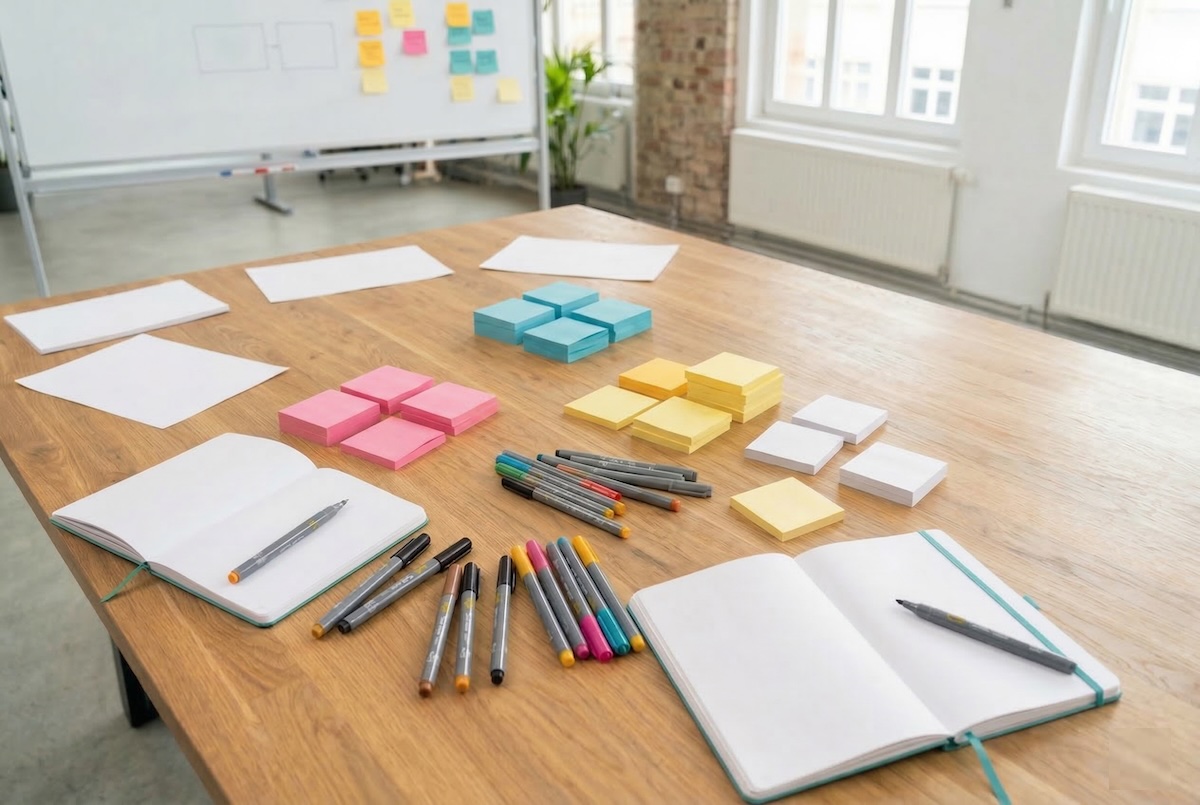
Table of contents
The critical errors happen long before this, run unnoticed throughout the entire development process and are more expensive to eradicate the longer they are ignored.
We are talking about (actual) basics such as clarity about user needs on the one hand and a lack of internal coordination between departments on the other.
UX workshops are the decisive tool here that kills (sometimes more than) two birds with one stone: they combine the knowledge of different stakeholders, transform vague ideas into tangible strategies and ensure that solutions are ultimately created that both inspire users and achieve KPIs.
What is a UX workshop actually?
A UX workshop is an intensive, time-limited session in which a multidisciplinary team works together on a specific design challenge.
In contrast to passive meetings, the focus here is on "doing" and joint decision-making. Participants generate a large number of ideas in a short space of time, visualize concepts and evaluate them directly in the team in order to obtain immediately usable results such as prototypes or prioritized roadmaps.
Aren't UX workshops just long meetings?
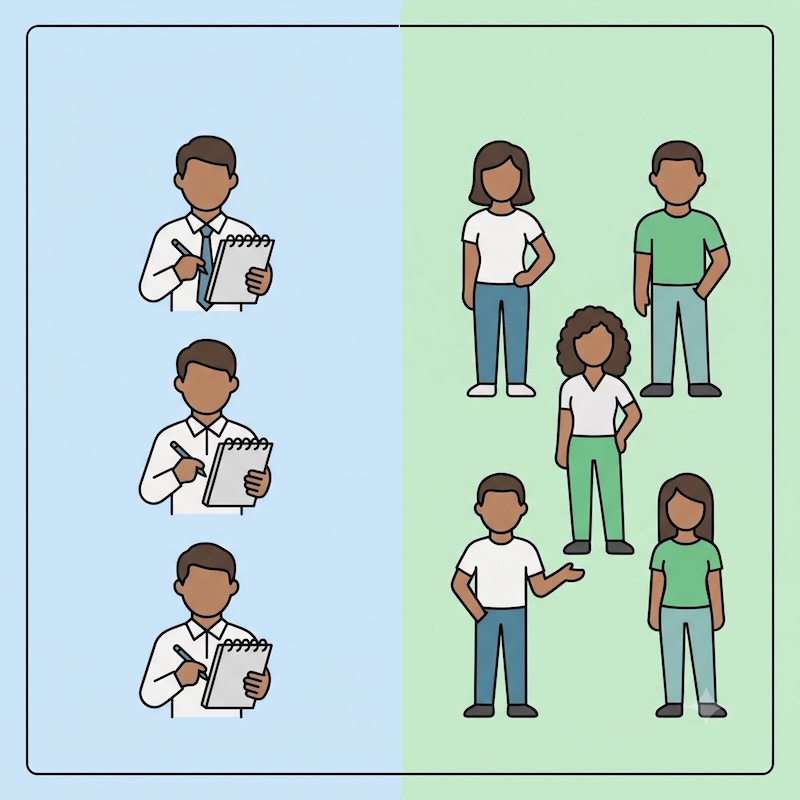
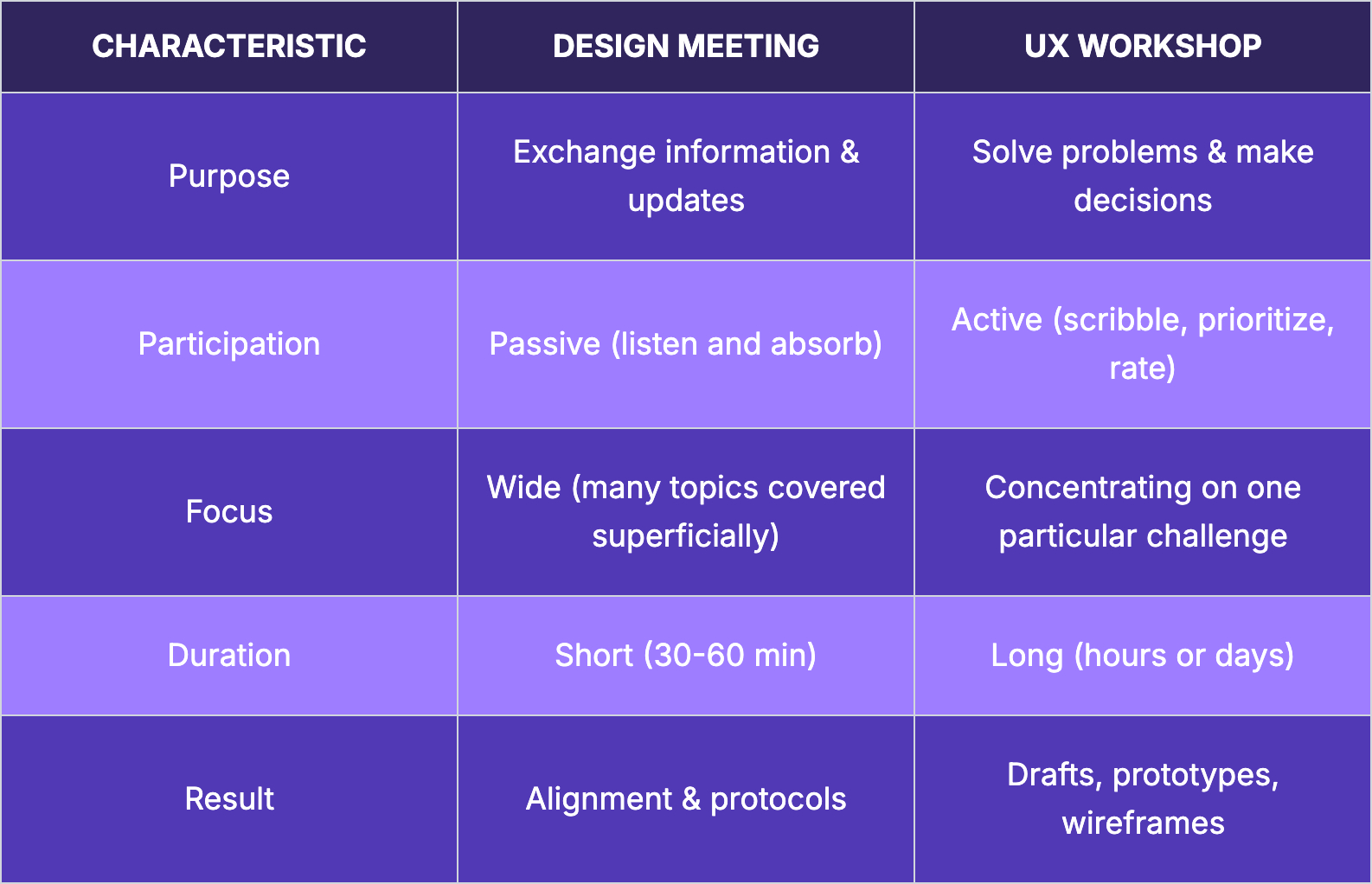
The key difference lies in the mindset: meetings are often passive and serve to exchange information. How often have you entered a meeting knowing that you won't say a word?
Workshops, on the other hand, are based on active collaboration to solve problems directly. This works by involving everyone present as active creators who create tangible results through methods such as sketching or brainstorming. While meetings often touch on many topics superficially, a workshop focuses in depth on a single challenge.
(Why) is it worth investing in workshops?
Investing in UX workshops pays off because it minimizes the risk of expensive mistakes and increases the efficiency of the entire team. Instead of investing months in developing features that no one will use in the end, workshops allow ideas to be validated at an early stage.
Here are some classic examples:
#1 Massive cost savings through error prevention
The cost of making changes to a product increases exponentially over the course of a project. A workshop in the early phase only costs the participants' time. If, on the other hand, an already programmed feature has to be completely revised due to poor UX, costs are incurred for design, development, quality assurance and re-deployment. This means a significant reduction in "waste" costs during development.
#2 Increasing the conversion rate & ROI
Certain workshop formats ensure that the functions with the highest user value are built first. When users reach their goals without friction, conversion rates increase directly. Means: Higher sales while keeping the marketing budget
#3 Reducing support costs & churn
Bad UX is often the invisible cause of a flood of support requests. When users are frustrated, they migrate to the competition. Empathy workshops help the team to understand these pain points and proactively resolve them. Meaning: Relief for customer service and long-term customer loyalty.
A practical example: The "silent" sales killer in the checkout
Imagine an e-commerce provider where 30% of users cancel the checkout process on the last page.
Without a workshop, the team would assume (!) that the shipping costs are too high. They are planning a multi-week discount campaign and technical adjustments to the pricing system. Costs: high. Result: Uncertain.
With a UX workshop (e.g. Critique or Empathy), a multidisciplinary team (developers, designers, stakeholders) could analyze session recordings together. A developer notices that a certain error message is hidden on mobile keyboards. A customer advisor adds that many customers ask for a specific payment method that is difficult to find in the interface.
Instead of rebuilding the pricing system, the interface is optimized within a few days. The abandonment rate drops immediately.
Workshops as an accelerator in decision-making
In traditional coordination processes, decisions often drag on for weeks as feedback loops are asynchronous and fragmented. UX workshops compress this process into a few hours by bringing all relevant stakeholders to the table at the same time. Methods such as "dot voting" or the "impact-effort matrix" achieve an immediate consensus based on facts and shared insights instead of endless discussions.
Why does collaboration promote shared ownership?
A UX workshop breaks down the classic silo mentality by actively involving backend developers, product managers and stakeholders from the outset. When the entire team participates in the development process, a shared understanding of the problem becomes the most important "currency" of the project. This direct involvement leads to a strong "buy-in": since the solution was developed together, everyone involved identifies with the result, which virtually eliminates later discussions of principles or questions such as "Why didn't we do it differently?".
How workshops minimize expensive undesirable developments
A UX workshop is your insurance against building without the user in mind. Instead of only realizing after months of development that a feature is not being used, workshops make risks and points of friction in the user journey immediately visible. By combining data, expert knowledge and the real voice of the user, assumptions are validated at an early stage. This "look behind the façade" prevents expensive course corrections in later phases and ensures that resources are invested where they will have the greatest impact.
Which workshop formats are available for which phase?
There is no "one" UX workshop that universally solves all problems. Instead, there is a variety of specialized formats, each of which starts at different points in the design process.
The structure varies depending on the issue and context: While some workshops aim to generate lots of new ideas in a short space of time, others serve to critically scrutinize existing concepts or prioritize complex roadmaps. You choose the tool based on the strategic gap that your team currently needs to close.
The discovery workshop to start the project
A discovery workshop forms the indispensable foundation for your product development. This is where the core team and key stakeholders come together to understand the current status quo and reach a robust consensus on project goals and milestones.
Instead of working on assumptions in isolation, this format pools the existing knowledge from various specialist areas and identifies business-critical requirements and potential risks at an early stage.
The goal is a measurable direction: you define the problem space precisely, identify the needs of your target group and define the scope for your MVP (Minimum Viable Product). This structured approach massively reduces uncertainty and ensures that valuable resources are invested in the right direction right from the start.
Checklist: When you need a discovery workshop
[ ] Project vision is still vague or unclear.
[ ] Stakeholders have different expectations of the outcome.
[ ] There are many unanswered questions about technical feasibility.
[ ] User needs are only guesses so far.
Get all the necessary knowledge in our ultimate guide to discovery workshops.
The empathy workshop better understand the users
An empathy workshop aims to create a deep emotional connection between the product team and the actual users. While data and reports often remain abstract, this format makes the needs, motivations and frustrations of the target group tangible.
Through methods such as persona walkthroughs or journey mapping, stakeholders immerse themselves directly in the user's world and learn to consistently make design decisions from their perspective.
The aim is a radical change of perspective: away from purely feature-driven development towards a genuine user-centric approach. By visualizing points of friction in the user experience, the team creates a common understanding of which problems really need to be solved. The end result is not only valuable knowledge, but the motivation to create products that offer real added value in people's everyday lives.
Checklist: When you need an empathy workshop:
[ ] Your team talks more about technical features than user problems.
[ ] There is user data, but the stakeholders have no feeling for the people behind it.
[ ] User feedback is often dismissed as "subjective" or ignored.
[ ] The user journey has high bounce rates whose emotional cause is unclear.
Get all the necessary knowledge in our ultimate guide to empathy workshops.
The design studio workshop to generate ideas
A design studio workshop is a highly structured and interactive process that aims to develop a variety of innovative solutions in the shortest possible time. In this format, the multidisciplinary team breaks away from pure theory and begins directly with the visualization of ideas through sketches. The focus is on quantity rather than quality in order to avoid perfectionism and promote the creative flow. Through iterative rounds of individual sketching, presentation and constructive team feedback, concepts are immediately refined and merged into a shared vision.
The aim is to develop creative, user-centered designs through intensive collaboration between various specialist disciplines such as design, development and product management. At the end of the workshop, concrete sketches or prototypes are created, which serve as a sound basis for further development. "Stealing" and reusing good approaches from colleagues is expressly encouraged in order to find the best possible overall solution.
Checklist: When you need a Design Studio workshop:
[ ] There is a standstill in brainstorming for a specific UX problem.
[ ] The team needs to quickly explore a wide range of different directions.
[ ] There is a lack of shared understanding about what a solution could look like visually.
[ ] Decisions about design directions should be made collaboratively and not in silos.
Get all the necessary knowledge in our ultimate guide to design studio workshops.
The prioritization workshop to create clarity in the feature jungle
A prioritization workshop is the most effective way to identify the truly value-creating initiatives from an overwhelming amount of ideas and feature requests. In this format, decision-makers and subject matter experts come together to objectively evaluate features based on criteria such as user value, business impact and technical effort. Structured methods such as the impact-effort matrix or the $100 test prevent the loudest argument from winning or the team from getting bogged down in details.
The goal is a shared, fact-based focus: the team agrees on a clear roadmap and avoids dangerous "scope creep", where projects expand uncontrollably due to ever new requirements. At the end of the workshop, there is a binding action plan that ensures that the limited resources available are used where they will achieve the greatest measurable success for the product.
When you need a prioritization workshop:
[ ] Your backlog is so big that no one knows what to build next.
[ ] Different stakeholders have competing requirements with the same urgency.
[ ] There is a lack of clarity about which features deliver the most value to users.
[ ] Development gets bogged down in "nice-to-have" features while core problems remain unsolved.
Get all the necessary knowledge in our ultimate guide to prioritization workshops.
The critique workshop to ensure design quality
A critique workshop is used to systematically and objectively evaluate existing designs or concepts to ensure that they achieve the set goals. At its core, it is not about personal opinions or "shooting up" designs, but about a structured feedback culture that reflects design decisions on user needs and business goals. By incorporating multidisciplinary perspectives - for example from developers or product managers - potential usability hurdles or technical inconsistencies are uncovered before the product goes into implementation.
The aim is to continuously refine and optimize the user experience. Participants often use established criteria such as usability heuristics to formulate constructive and well-founded feedback. The end result is a shared understanding of which parts of the design are already working and where targeted improvements are needed to ensure high product quality.
When you need a critique workshop:
[ ] Feedback rounds are often unobjective or based purely on personal taste.
[ ] There is uncertainty about whether the current designs really solve the users' problems.
[ ] Important stakeholders feel ignored in design decisions or don't understand the logic behind them.
[ ] You want to improve design quality by pooling expert knowledge from different departments.
Get all the necessary knowledge in our ultimate guide to critique workshops.
Can you combine different workshop formats?
In practice, these formats rarely exist in a vacuum. Experienced teams use workshops as a "construction kit" and combine elements depending on the time budget and complexity.
For example, a Discovery Workshop can transition seamlessly into a Prioritization Session in order to cast the goals that have just been defined directly into the first roadmap. It is also common to conclude a Design Studio workshop with a short critique round so that the resulting sketches can be immediately evaluated and filtered for the next sprint. These hybrid approaches are particularly valuable in agile or lean environments, as they minimize bureaucratic overhead and maximize output.
What are the success factors for implementation?
A workshop is only as good as its preparation and the dynamics in the room. To ensure that the hours of joint work don't turn into an expensive waste of time, the framework conditions have to be right. It's about creating an environment in which creative solutions can emerge and every voice is heard.
Who should take part in the workshop?
The strength of a UX workshop lies in the diversity of perspectives. An ideal team usually consists of 4 to 8 people and is multidisciplinary: Product owners for the business view, subject matter experts for the domain expertise, UX designers for the user perspective and devs for the technical feasibility. Where possible, it is particularly valuable to involve real users or customer representatives in order to validate assumptions directly on site.
What role does the moderator play?
An experienced facilitator is the neutral helmsman of the workshop. He or she pays strict attention to timeboxing to prevent discussions from getting out of hand and ensures that all participants - even the quieter ones - actively contribute. The moderator also ensures that the team remains constructive in the event of conflicts and that clear, documented decisions are made at the end of the day.
What preparation is necessary for good results?
Good workshops start days before the actual date. In addition to defining a clear goal and a precise "how-might-we" question, providing context is crucial. Share existing research results or personas with the team in advance so that all participants start with the same level of knowledge. Whether on site with whiteboards and markers or remotely with tools such as Miro or Mural - the setup must function smoothly so as not to disrupt the creative focus.
Conclusion: From plan to measurable improvement
UX workshops sustainably ensure the quality of digital products. By breaking down silos and making decisions based on facts rather than opinions, you save valuable development resources and create experiences that your users really need. Whether you are at the beginning of a vision or want to optimize a complex system: The right workshop format will give your team the clarity and momentum they need to take the next big step.
Regular UX reviews and collaborative sessions prevent your product from losing relevance over time. Use the formats presented here as a building block to professionalize your product strategy step by step.
Ready for the next step in your product development?
Uncover the full potential of your digital product. In a free call with our co-founder Victoria, we will analyze your current situation and find out which workshop will help you move forward most efficiently now.