July 1, 2026
Updated on
August 31, 2026
UX Audit vs. Usability Test: Which Method Solves Which Problem?
You're facing a budget decision: Is a quick expert review enough to find your usability issues, or do you need to put real users in front of the interface? The two methods sound interchangeable, but the wrong choice will cost you either money or clarity.


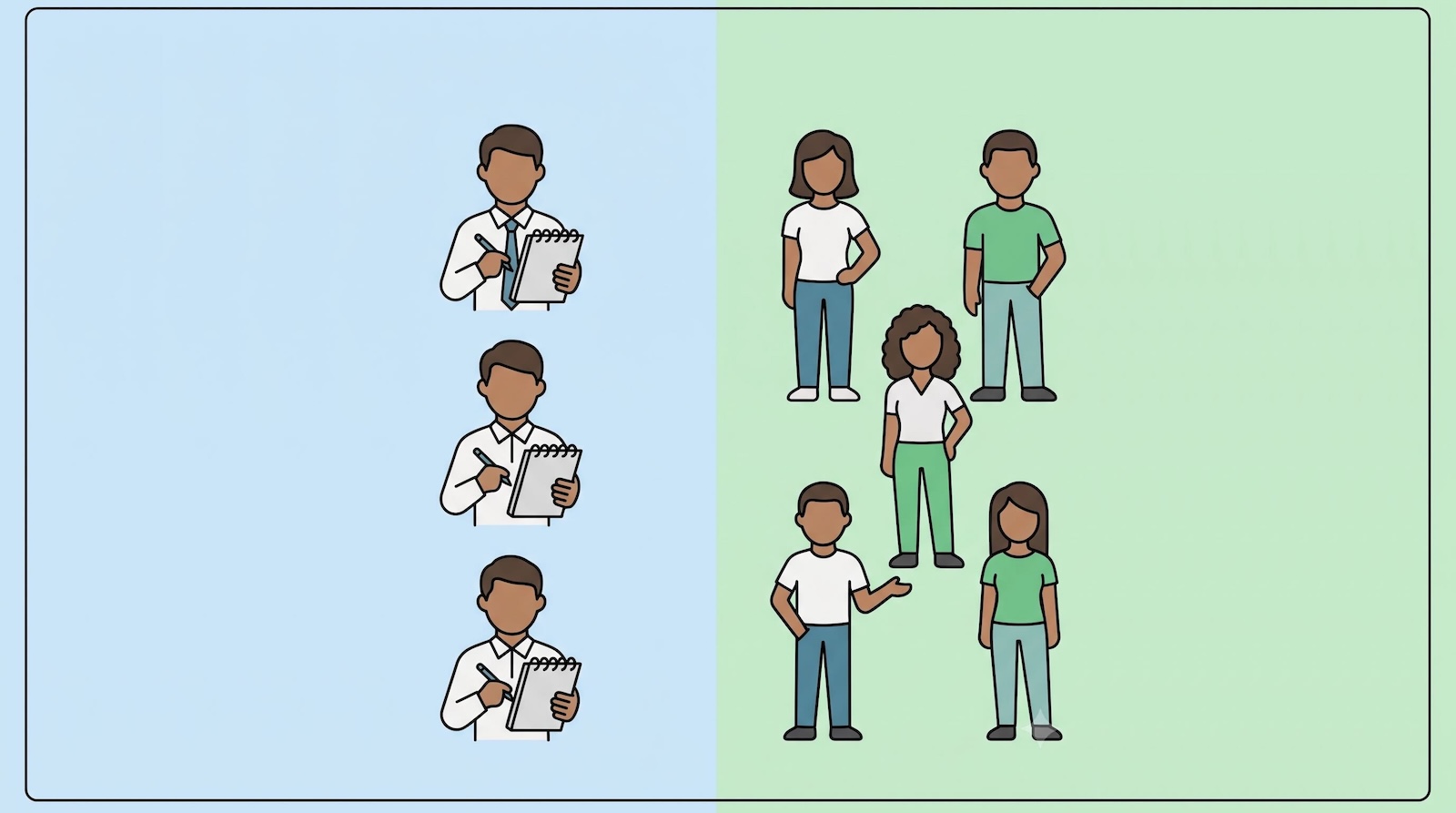
Table of contents
In this article, you'll get the core difference at a glance, proven figures on what each method finds and overlooks, a cost and duration comparison, and a decision tree that guides you to the right method in just a few yes/no steps: audit, test, or both. To anticipate: The methods complement each other more often than they compete.
Key Takeaways
For a quick overview, here are the key points summarized.
- Core Difference: A UX audit is an expert judgment without real users; a usability test is observed behavior of real users performing real tasks.
- The Key Statistic: Heuristic evaluations find, on average, about 36% of the problems that appear in usability tests (range 30 to 43%), according to an analysis of several studies by MeasuringU.
- Rule of Thumb: The audit quickly uncovers obvious problems; the usability test validates the non-obvious, behavior-based ones.
- Cost: An audit is usually cheaper and faster because no recruiting or incentives are needed. A test is more complex but more valid.
- Best Strategy: Combine both: Use an audit as an inexpensive first filter, then conduct targeted tests on critical areas.
Further down, a decision tree clarifies which method is appropriate for your situation first.
Core Difference: Expert Judgment vs. User Behavior
The difference lies in the data source. In a UX audit, an experienced UX expert evaluates the interface against established usability principles like Nielsen's 10 heuristics and known guidelines, without any real users involved. In a usability test, real users perform specific tasks, and you observe what actually happens: where they hesitate, click, fail, or give up.
A clear distinction helps avoid confusing the terms. A heuristic evaluation is an informal usability inspection method where one or more experts examine a user interface and identify potential problems based on established usability principles. It is therefore a form of expert review. A UX audit is broader in scope, often combining heuristic evaluation, analytics, user research, competitor analysis, and an assessment against your business goals. You can find an in-depth look at individual heuristics in our article on heuristic evaluation – this section focuses solely on the distinction.
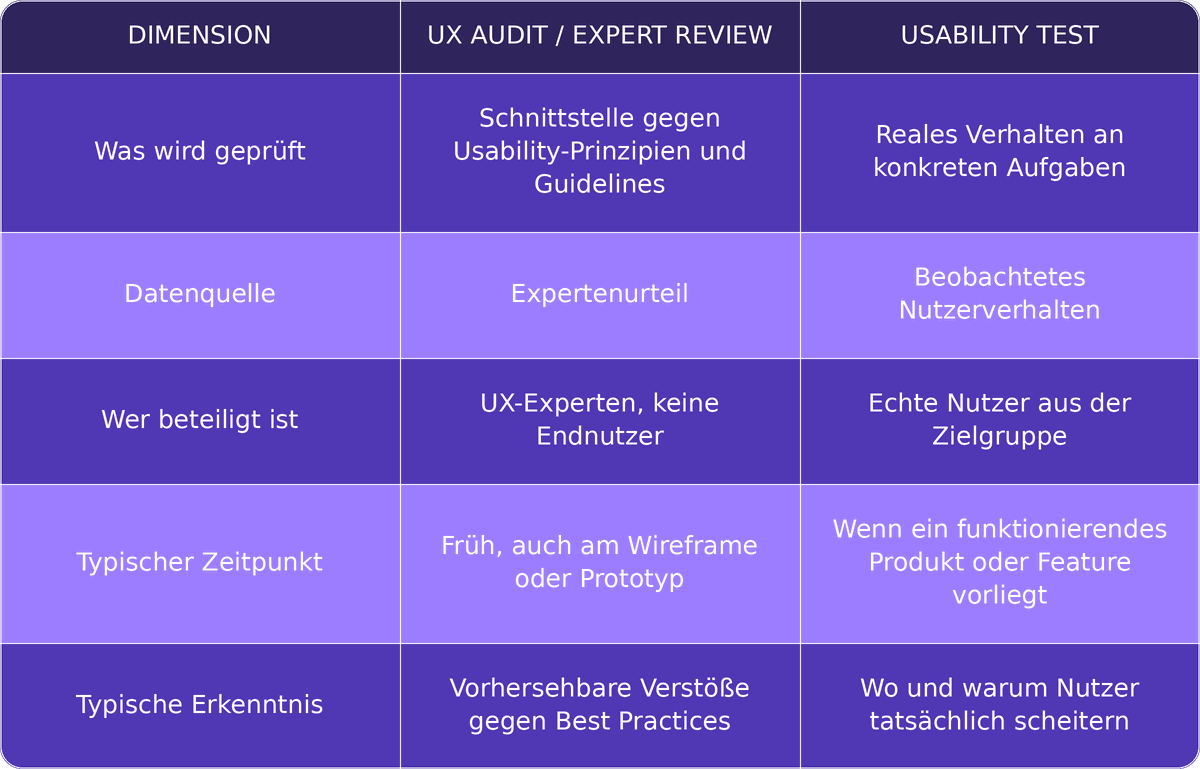
The following table answers the most common question on the topic: What's the actual difference?
What a UX Audit Finds
An audit quickly and affordably provides a broad overview. It catches predictable usability violations that can be identified without users: inconsistent navigation, missing feedback after an action, unclear labels, error-prone workflows. This is precisely where it excels.
The advantages at a glance:
- Deployable early: An audit works even on a wireframe or prototype, long before real users could test it.
- Fast: The heuristic core of an audit requires few experts. Nielsen's rule of thumb suggests 3 to 5 evaluators, each spending 1 to 2 hours, meaning this inspection can be completed in days rather than weeks.
- More cost-effective: No recruiting, no incentives, no test lab.
- Broad coverage: An audit can scan the entire interface, whereas a test focuses on a few specific tasks.
It's important to honestly state the limitations. An expert cannot reliably predict where real users with specialized knowledge, such as medical professionals or industrial operators, will encounter difficulties. Both heuristic evaluation and user testing can overlook problems, which is why it's best to use both methods. An audit shows you what violates the rules, but not always what truly bothers users in a real-world context.
You can find the complete process, including a checklist, in the full UX Audit Guide.
What only a usability test reveals
First, the most important figure: An analysis by MeasuringU across several studies shows that heuristic evaluations on average find about 36% of the problems that appear in a usability test (range 30 to 43%). More broadly, it holds that heuristic evaluations typically find between 30% and 50% of the problems uncovered by a parallel usability test.
These figures lead to an uncomfortable conclusion. If a pure expert review catches only about one-third of the problems actually observed, the majority of what users truly struggle with remains invisible in the audit. A study on dental software corroborates this from the other perspective: On average, 50% of the empirically determined usability problems were identified by the preceding heuristic evaluation. Even in the better case, about half are still missed.
Crucially, the methods largely find different things and only partially overlap. The study by Fu, Salvendy, and Turley (2002) found that heuristic evaluation with experts is more effective at uncovering problems at the skill- and rule-based level, while user testing is more effective at finding problems at the knowledge-based level. In other words: The audit is good at identifying predictable rule violations, while the test reveals what only becomes apparent during actual use. The overview of usability testing methods will help you determine which testing method is best suited to your question.
What only a usability test reveals:
- The Unexpected: Paths and misunderstandings that no expert would have foreseen.
- Contextual Problems: How the product performs in real workflows, under time pressure, or with real data.
- The 'Why': Not just that users fail, but what thought or expectation is causing the problem.
- Robust Evidence: Videos and observational data that convince stakeholders where expert judgment is dismissed as mere opinion.
Costs and Duration Compared
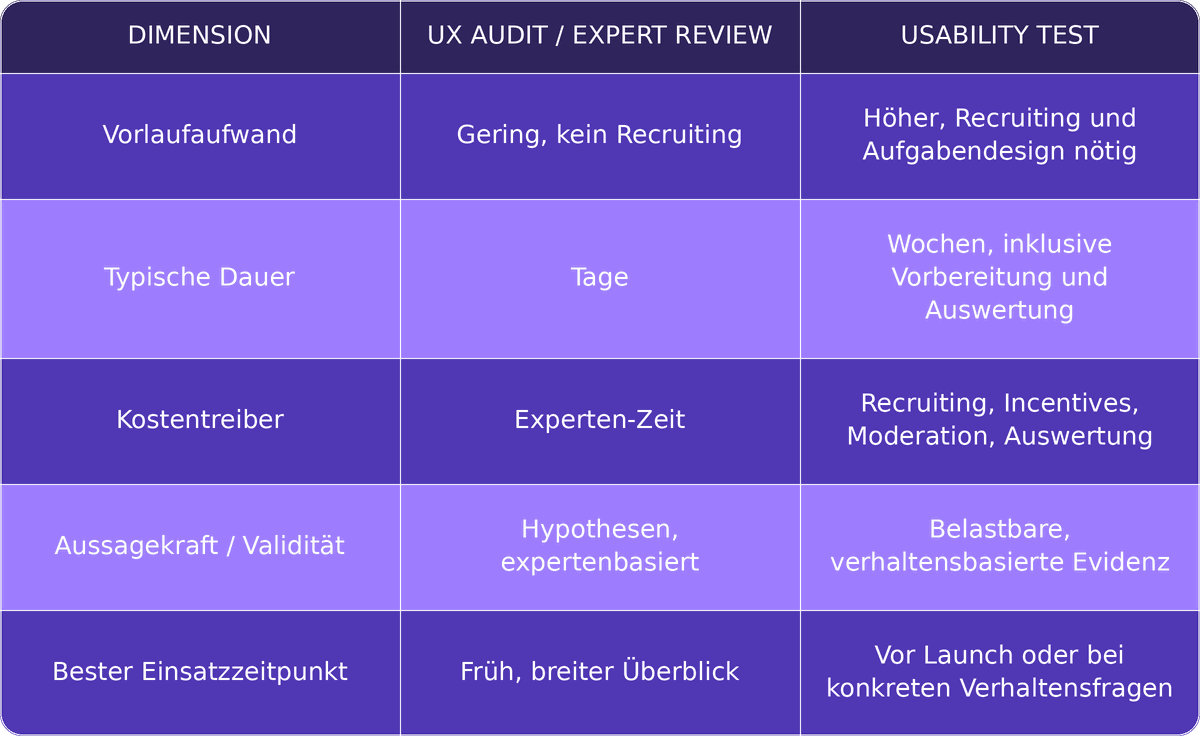
An audit is generally cheaper and faster because it doesn't involve recruiting, incentives, or test setup. A usability test is more complex, but it provides more valid, behavior-based evidence. The biggest cost factor in the test is the number of participants; we've broken down how many participants you actually need in a separate article.
Cheaper doesn't mean better. The choice of method depends on the question you want to answer, not solely on the budget. If you need to know why users abandon a checkout process, the cheapest audit in the world won't help you.
Decision Tree: What do you need first?
Instead of a general recommendation, here's a clear path. Answer the questions in order until you arrive at a recommendation.
- Are you in an early design or wireframe phase and don't have any user data yet? If yes, start with an audit – it quickly provides a broad overview before you invest in tests. If no, proceed to Question 2.
- Do you know the symptoms (e.g., abandonments, low adoption) but not the causes or priorities? If yes, start with an audit to sort out the obvious violations, and plan the test based on that. If no, proceed to Question 3.
- Do you need to understand specific user behavior, validate a new feature before launch, or provide stakeholders with reliable evidence? If so, a usability test is essential. If the answer is partially yes to everything, then both are needed, in the order mentioned below.
The rule of thumb for the order is: The audit quickly uncovers obvious problems – address these first – and the subsequent usability test validates the non-obvious, behavior-based problems that an expert couldn't identify.
Depending on your situation, the next step varies. If your path leads to an audit, a UX audit is the quick start. If you need real user behavior, usability testing is the method of choice. In most serious projects, you'll ultimately need both.
Combining Both Methods
The most effective approach combines both methods because they uncover different types of problems. Since both heuristic evaluation and user testing can each overlook problems, it's best to use both: If the audit finds about a third of the problems and the test primarily finds others, they complement each other almost perfectly.
In practice, the process looks like this: The audit serves as an affordable first filter and a basis for planning. It addresses obvious violations and highlights areas that remain unclear. These unclear areas become the focus hypotheses and tasks for the subsequent usability test. This way, the audit refines the test (you are no longer testing blindly, but specifically targeting critical points), and the test, in turn, validates whether the problems suspected in the audit truly affect real users. Fu et al. (2002) conclude that usability researchers should first conduct expert inspections to eliminate skill- and rule-based errors in early design phases, and then proceed with user testing.
Your Next Step
If you need reliable evidence and real user behavior, a usability test is indispensable; ideally with an additional usability test, if your budget allows. The appropriate sequence for your project depends on its phase, your existing data, and the question you need to answer.
Book a free initial consultation with brightside Studio. In a discussion, we will jointly determine which method is right for your project and what the specific roadmap looks like. You can also find a broader overview of the topic in our Usability Testing Guide.
UX Audit vs. Usability Test FAQ
Was ist der Unterschied zwischen einem UX Audit und einem Usability Test?
A UX audit is an expert judgment: A UX specialist evaluates the interface against usability principles and guidelines, without involving real users. A usability test is observed user behavior: Real users perform tasks, and you see where and why they actually fail.
Ist eine heuristische Evaluation dasselbe wie Usability Testing?
No. Heuristic evaluation is a form of expert review where specialists evaluate an interface against established heuristics – entirely without real users. Usability testing, on the other hand, involves real users performing real tasks. You can find details and examples of heuristics in our article on heuristic evaluation.
Was ist günstiger – ein UX Audit oder ein Usability Test?
Generally, a UX audit is cheaper and faster because it doesn't involve recruiting, incentives, or test setup. A usability test costs more and takes longer, but it provides reliable, behavior-based evidence. Which method makes sense for your budget primarily depends on how certain your answer needs to be.
Welche Methode sollte ich zuerst wählen?
As a rule of thumb, start with the audit for a quick, broad overview, then conduct the usability test to validate non-obvious problems. This way, you fix predictable issues cost-effectively upfront and invest testing resources strategically in critical areas. The decision tree above clarifies the right approach for your specific situation.
Reicht ein UX Audit alleine aus?
If you need real user behavior and reliable evidence, an audit alone is not sufficient. Heuristic evaluations, on average, only uncover about 36% of the problems that appear in a usability test – the rest remain hidden from a pure expert review. For a complete picture, you should combine the audit with a usability test.