June 29, 2026
Updated on
Are 5 users enough? How many participants does a usability test require
You're planning a usability test and want to start looking for testers. You might have heard somewhere that five users are enough. Is that really true?



Table of contents
The famous 5-user rule holds true on average, but it's not a guaranteed value, and precisely this difference determines whether your results are reliable.
The short answer: This is how many test participants you need
For qualitative tests designed to uncover usability issues, 5 test participants per user group and iteration are usually sufficient. If, however, you want to statistically prove metrics like success rates or task completion times, you'll need a benchmark of 20 or even more users. The crucial factor is therefore your test goal: finding problems or proving numbers. And in almost all cases, several small, sequential tests achieve more than one large test.
Key Takeaways
- The test goal determines the number. Qualitative tests (finding problems) can manage with small samples, while quantitative tests (proving metrics) require significantly more.
- 5 users find an average of about 85% of problems. This value applies under the assumption that a problem is noticed by an average of about 31% of users. 31% is an average, not a threshold. Rare problems usually remain undiscovered.
- The average conceals the variation. The Faulkner study shows that individual 5-user tests found between 55% and 99% of problems.
- 5 applies per homogeneous user group. For clearly separated segments, you need separate test participants for each group, and the total number increases accordingly.
- Iteration beats a perfect one-off number. Testing twice with 5 users, with a fix in between, yields more insights than testing once with 10.
- The worst option is not to test at all. Even a single real user provides more than any internal discussion.
The 5-User Rule: What Nielsen Really Said
The 5-user rule is a mathematical model developed by Thomas K. Landauer and Jakob Nielsen in 1993. Nielsen eventually popularized it in 2000 with his article “Why You Only Need to Test with 5 Users”, in which he argued that five test subjects uncover approximately 85% of usability problems.
The formula behind it is N(1 − (1 − L)n).
Where N is the total number of usability problems in the design and n is the number of test subjects. L is the proportion of usability problems discovered when testing with a single user, and the typical value for L is 31%, averaged across a large number of studied projects. If you plug L = 31% and n = 5 into the formula, the expected value is approximately 85% of problems found.
The most overlooked point lies precisely in this L-value. The 85% is an expected value across all problems, and this expected value only holds true under the assumption that, on average, a problem is noticed by approximately 31% of users. Most people either omit this crucial detail or fail to understand it. Because 31% is an average, not a threshold: Some problems are obvious to almost everyone, while others are noticed by only a few. You are almost certain to discover common problems with five users, but rare ones are highly likely to be missed entirely. The rarer a problem is, the more likely it is to escape your notice.
This is based on the principle of diminishing returns. As soon as you collect data from a single test user, your insights skyrocket, and you've already learned almost a third of everything there is to know about the design's usability; the difference between zero and even a little data is astonishing. However, with each additional tester, observations overlap more because multiple people encounter the same stumbling blocks.
It's important to note what the rule does not claim. It says nothing about what percentage of your real users will encounter a specific problem. This is a qualitative method for finding problems, not a statistical method for measuring frequencies. Anyone who uses the 5-user rule for success rates or benchmarks is misusing it.
Where the Formula Breaks Down: The Faulkner Study
The average only tells half the story. In 2003, Laura Faulkner provided the empirical counter-test with her study „Beyond the five-user assumption“ in Behavior Research Methods. In this study, a total of 60 users were tested, and random sets of 5 or more were drawn from the total group to illustrate the risks of using only 5 participants and the benefits of more; some of the randomly selected 5-user sets found 99% of the problems, others only 55%, and with 10 users, the lowest problem detection rate found by a set rose to 80%, and with 20 users, to 95%.
The spread is the actual result. This is how reliable 5, 10, or 20 test participants are in the worst-case scenario:
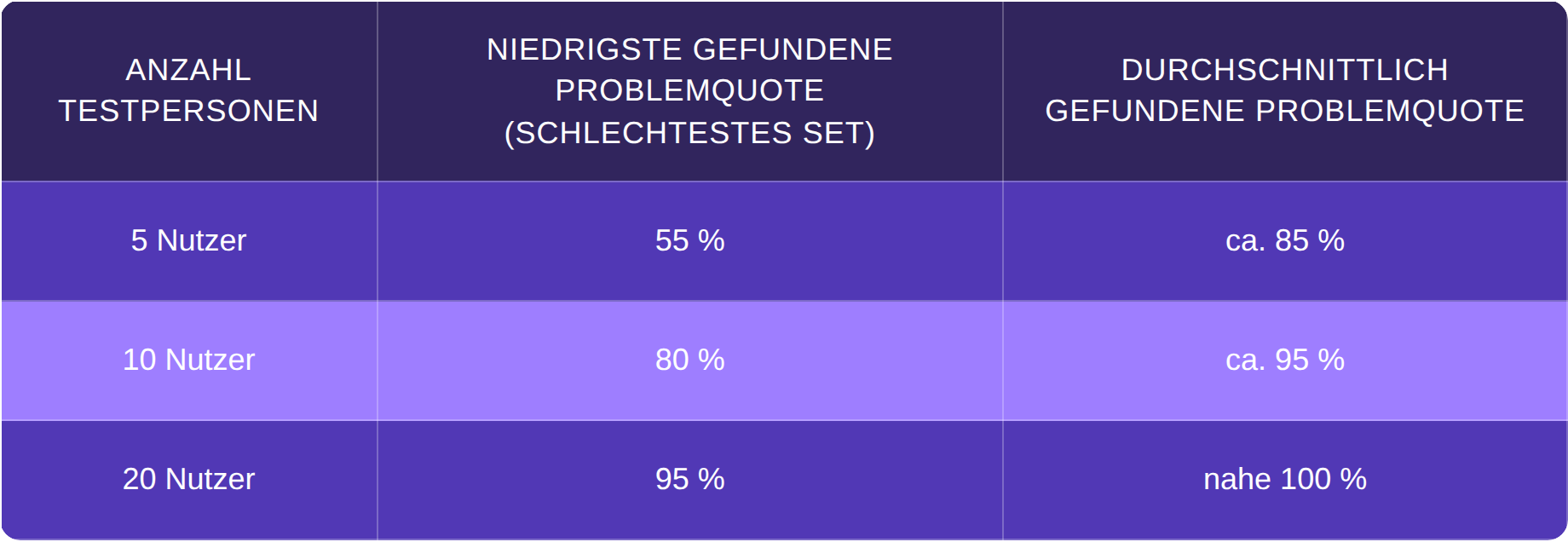
The values are from Faulkner (2003); some secondary sources cite a slightly different lower bound for 10 users. The table's message remains the same.
On average (!), Faulkner thus confirms Nielsen. As predicted by the Nielsen formula, the average percentage of usability problems found was 85% in 100 tests with five users. However, this percentage varied considerably across the spectrum, because with "bad luck," a single 5-user test might only find just over half of the problems. Larger sample sizes reduce this variance and make your results defensible to stakeholders.
Faulkner is not alone in her criticism. Previously, Spool and Schroeder, as well as Perfetti and Landesman, had documented cases where five users, especially with complex websites involving many different tasks, remained significantly below the 85 percent mark. Across the 100 simulated tests, the proportion of usability problems found with five participants ranged from nearly 100% down to just 55%; as any good statistics freshman could predict, small sample sizes lead to a large variation in results between runs.
Qualitative or Quantitative: The Sample Decides
Before you argue about a number, clarify the underlying question: Do you want to find problems or prove numbers? This distinction determines the sample size more than any rule of thumb.
Qualitative tests aim to uncover problems and understand the "why." Small, iterative samples are useful here – often 5 to 8 per user group in practice. You observe where people get stuck, listen to their reasoning, and derive improvements. Beyond a certain point, more testers primarily yield repetitions of the same insights.
In quantitative tests, you want to statistically validate metrics such as success rates, task completion times, or satisfaction scores. For this, you need significantly larger samples, with a guideline of 20 or more per condition. A success rate derived from five people has a huge confidence interval and cannot withstand critical scrutiny.
There's another factor that drives the required number up: the quality of your interface. The better your interface already is, the less often users stumble, the L-value decreases, and you need more testers for the same coverage. If L is at 20%, you need 9 users to find 85% of the problems, and if L is at 10%, you need 18 users – the more usable your interface is, the more users you need to involve to identify 85% of the usability problems.
For the specific sample size with standard questionnaires like SUS and for valid measurements, it's worth taking a look at our article on UX ROI and the impact of good usability. The article on usability KPIs explains how to accurately calculate and interpret SUS, Task Success Rate, and Time on Task. The individual methods themselves are covered in detail in the Methods article of the Hub.
Properly covering multiple target groups
The 5-user rule applies per homogeneous user group, not for the entire product. This is precisely the part Nielsen co-authored, and it's constantly overlooked. If your product has significantly different user groups, then you must involve separate testers for each of these user groups.
You have different user groups when your users differ in key aspects:
- Experience level: Beginners and professionals encounter completely different hurdles.
- Role in the system: A B2B administrator uses a platform differently than an end-user.
- Usage context: Someone working at a desk has different needs than someone on the go.
The practical rule is simple: Plan for separate testers for each clearly distinct segment. We often see this with products that have multi-faceted user structures, because a marketplace or a FinTech platform often serves buyers, sellers, and operators simultaneously, and each of these roles needs its own five testers, because their tasks and expectations are simply different.
The same applies to end devices and use cases. A sample of five applies per device and per core task. Anyone who lumps desktop and mobile together mixes two tests into an unclear result.
Practical Recommendation based on Test Goal
Instead of a fixed number, here's a decision-making guide. This table answers the question of how many test participants you need for your specific test objective:

These values are more guidelines than strict rules. The specific context, such as product complexity, design quality, and target audience size, can shift them up or down.
One truth remains above all numbers: the worst option isn't testing with too few participants, but not testing at all. Since the number of participants is a key cost driver, it's worth examining the specific cost factors of a usability test before budget approval.
Why 2x 5 is better than 1x 10
The greatest leverage comes from repetition, not from a perfect one-off number. If you have the budget for 15 testers, don't invest it in a single large study; instead, opt for three smaller ones.
The reason lies in the objective. You want to conduct multiple tests because the true goal of usability engineering is to improve the design, not just to document its flaws. After the first study with five participants identifies 85% of the usability issues, you'll want to address these problems in a redesign, and then you'll need to test again after the new design is implemented.
A second round of testing isn't a luxury. Even if the redesign is intended to "fix" the issues found in the first test, the truth is you only *believe* the new design will overcome those problems. Since no one can design a perfect interface, there's no guarantee that the new design will actually resolve the issues. Every redesign can introduce new stumbling blocks, and only a second round of testing will catch them.
In practice, the success of each round hinges on having the right people in front of the screen. Five random individuals don't constitute a test – you need five genuine representatives of your target audience. If you prefer not to handle this yourself, we can help you recruit the appropriate test participants and Usability Tests with Real People conduct them. We delve deeper into which method suits which question and how the entire testing process is structured in our Guide to Usability Testing; a faster, expert-based alternative can be found in the Contribution to Heuristic Evaluation.
What You Should Do Next
Start with 5 participants per user group for a qualitative test, and from the outset, plan for at least two rounds with a fix in between. Only increase to 20 or more if you require robust data, such as success rates.
The immediate first step: Define your testing goal before considering the number. Is the goal to identify problems, or to validate metrics? Based on this answer, you can directly derive the sample size from the table above.
If you prefer not to recruit the right participants or moderate the sessions yourself, contact us. In a no-obligation initial consultation we will discuss your testing goal and the appropriate sample size together.
FAQ on the Number of Participants in Usability Tests
Are 5 participants enough for a usability test?
Yes, for qualitative tests per target group, because five users on average find about 85% of usability problems. The variation is important: individual 5-user tests can also uncover only about half of the problems. Therefore, you should iterate and plan for at least two rounds with a fix in between, instead of relying on a single run.
What is the 5-user rule?
The 5-user rule is a mathematical model by Nielsen and Landauer from 1993, later popularized by Nielsen's article in 2000. It states that five users on average find about 85% of usability problems. However, this value applies under the assumption that a problem is noticed by about 31% of users on average – 31% is an average, not a threshold. Rare problems are usually overlooked with five users.
How many participants do I need for a quantitative test?
Significantly more than for a qualitative test – as a guideline, 20 or more per condition to make statistically reliable statements. Success rates, task completion times, or satisfaction scores from only five people have too large a confidence interval. For the exact sample size for standardized questionnaires like the SUS, it's worth consulting materials on valid usability measurement.
What does the Faulkner study show?
In 2003, Laura Faulkner tested a total of 60 users and drew random samples from them. Some 5-user sets found 99% of the problems, while others found only 55%. With 10 users, the lowest rate was 80%, and with 20 users, it was 95%. The study confirms Nielsen's average but highlights the high variance of small samples.
How many participants for multiple target groups?
Plan for separate testers for each clearly distinct user group, because the 5-user rule only applies to comparable users who use a product similarly. With significantly different roles, experience levels, or usage contexts, the total number increases accordingly. A product with three separate target groups therefore needs 15 rather than 5 participants.
Is one large test better than several small ones?
No. Several small, iterative tests with a fix in between provide more value than a single large test. They improve the design round by round and simultaneously check whether your corrections really work – and whether the redesign has introduced new problems. Instead of testing 10 once, it's better to test 5 twice.