June 24, 2026
Updated on
August 31, 2026
Customer Journey Touchpoints: Find, Evaluate, Utilize [+ B2B List]
Those looking for Customer Journey Touchpoints often think of advertising channels and funnel stages. Understandable.


Table of contents
But the touchpoints that truly determine loyalty or churn are rarely found in the marketing dashboard. This article provides a method to find all touchpoints (even the invisible ones), categorize them, and evaluate their emotional impact.
Key takeaways at a glance
A touchpoint is any moment a person interacts with your company or product. It doesn't matter whether it was intentionally designed or occurred by chance. These touchpoints can be divided into three categories: digital, analog, and human. Especially those points that no one actively designs, such as an automatic payment reminder, a cryptic error message, or a delayed support response, often have the strongest emotional impact.
Below, you will find a B2B table with over 20 specific touchpoints as a starting point for your own audit. Important to note: A touchpoint list alone is raw material. Touchpoints only unleash their full potential when you place them chronologically and emotionally within a Journey Map.
Types of Touchpoints: digital, analog, human
A Customer Journey Touchpoint is any point of contact between a person and a company or product: directly experienced (website, conversation, packaging) or indirectly perceived (review, recommendation, press article). Touchpoints encompass everything that triggers a perception, regardless of whether the company actively designed the moment.
Three categories help with sorting:
- Digital: Website, App, Email, Chatbot, In-app error message, Release Notes
- Analog: Packaging, printed invoice, brochure, exhibition stand, business card
- Human: Sales call, Support call, Onboarding call, On-site training
A second axis makes the categorization practical: Owned (your own channels that you control) vs. Earned (reviews, word-of-mouth, press reports). This distinction is crucial for prioritization. You can directly improve owned touchpoints. For earned touchpoints, you only influence the cause, not the moment itself.
The third axis categorizes touchpoints chronologically: before purchase (Pre-Experience), during use (During), and after use (Post-Experience). Combining all three axes creates a grid that reveals blind spots. Most teams discover that their post-experience touchpoints are almost entirely unmanaged.
The Touchpoint Inventory: how to find all contact points
A complete touchpoint analysis doesn't start at the whiteboard, but with your data. Three steps lead from the initial source to the complete list.
Step 1: Tap into sources
Start with what already exists. Google Analytics shows entry pages and exit points. Support ticket categories reveal where friction occurs. Sales call notes document which questions repeatedly arise before purchase. Churn interviews provide the most honest insights into which touchpoints ultimately make the difference. App store reviews show what users publicly name.
Step 2: Team Workshop
Gather representatives from Product, Sales, Support, and Customer Success in one room. Each person writes down all touchpoints they know (including seemingly trivial ones). Experience shows: Sales knows touchpoints that Product never sees, and vice versa.
Step 3: Search for blind spots
The crucial question is: Which touchpoints exist without anyone in the room having actively designed them? Contact points such as automated emails, system-generated error messages, or standard invoice texts arise as byproducts of technical processes and often remain untouched for years.
An example from a B2B SaaS project: In the workshop, the team discovered that the automated onboarding email on day 3 after registration was the most frequently mentioned pain point in churn interviews. Everyone in the room knew about the email. No one was responsible for it. It had been set up two years prior and never adjusted since.
Example List: 20+ B2B Touchpoints
This table covers the entire B2B lifecycle. Use it as a starting point for your own inventory.
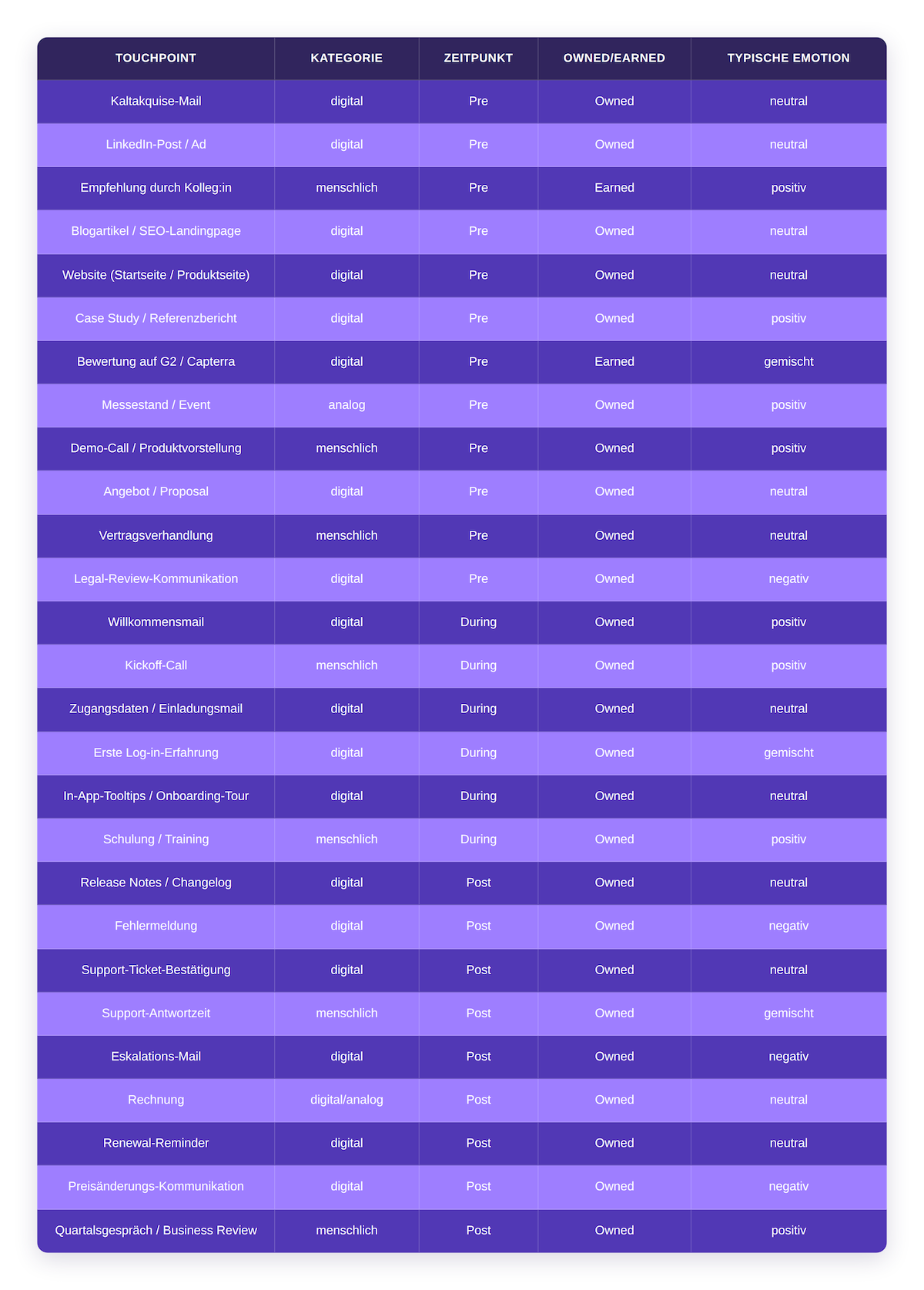
In an e-commerce context, other key areas come into play: product detail page, shopping cart interaction, checkout process, shipping confirmation with tracking, package opening (unboxing), and returns process. These six touchpoints cover the most important emotional moments in B2C online purchasing.
Evaluating Touchpoints: Frequency, Emotion, Moments of Truth
A list is a start. The real work begins with evaluation. Two dimensions are sufficient for this: How often does this touchpoint occur (frequency)? And how strongly do your users react to it (emotional intensity)?
Touchpoints with high frequency and high emotional intensity are your Moments of Truth, meaning the moments that decide between loyalty and churn. The term originated in the consumer goods industry and has become established in three variants: the Zero Moment of Truth (the research phase before purchase), the First Moment of Truth (the first impression), and the critical moment of use directly after purchase.
For practical evaluation, we recommend a simple Pain/Gain scale from -2 to +2 per touchpoint, combined with a frequency score (rarely / occasionally / frequently / with every user). A 2x2 grid based on these two axes sorts your touchpoints into four quadrants - and the top-right quadrant (high frequency, strongly negative emotion) shows you where you should act first.
An important point: The emotion data should come from customer interviews and support evaluations, not from your team's assumptions.
From Touchpoint List to Journey Map
A touchpoint list itself is not yet a story. Only the journey map organizes these contact points into a chronological and emotional flow, making gaps in outcomes visible. Touchpoints form the rows of the map, emotions draw the curve, and the combination of both creates pain points and opportunities.
If you are looking for the complete step-by-step guide to building a journey map, you will find it in the User Journey Mapping Guide. For anyone who still wants to differentiate between Customer Journey and User Journey, the Comparison of both concepts provides further assistance.
The inventory itself can be effectively developed within your own team. However, evaluation and prioritization require structured methods and often an external perspective. Those who want to approach this systematically can analyze touchpoints and their impact systematically in a journey-mapping workshop.
Conclusion
Touchpoints are the foundation for informed product decisions. Here are three next steps:
- Review existing data sources: Examine support tickets, analytics data, and churn interviews for touchpoint signals.
- Leverage the B2B table as a basis: Use the list from this article as a starting point for an internal inventory session and add product-specific contact points.
- Identify Moments of Truth: Find the touchpoints with the highest emotional impact and place them on a journey map.
To find out which touchpoints in your product truly drive loyalty or churn, you need user data. Not assumptions.
Customer Journey Touchpoints FAQ
What is a touchpoint in the customer journey?
A touchpoint is any point of contact between an individual and a company – direct (website visit, conversation with sales) or indirect (a review on a comparison platform, a recommendation from colleagues). Crucially, even points of contact you don't actively design are touchpoints. A system-generated error message shapes the perception of your product just as much as a well-designed landing page.
How many touchpoints does a typical customer journey have?
The range is wide. Simple B2C purchases involve 5 to 10 touchpoints, while complex B2B purchasing decisions can include 20 to 40 or more. The exact number depends on the product, industry, and decision-making structure. More important than the total number is the quality of the analysis: Five well-understood touchpoints are more valuable than a list of 50 unanalyzed entries.
What is the difference between a touchpoint and a channel?
A channel is the medium – for example, email, phone, or your website. A touchpoint is the specific interaction within that channel. Email is the channel. The welcome email on day 1 after contract signing is the touchpoint. This distinction is important because you can evaluate channels broadly, but touchpoints must be individually designed and optimized.
Who in the company is responsible for the touchpoint audit?
No single department. Touchpoints are spread across product, sales, support, customer success, and marketing – which is why the audit only works cross-functionally. Typically, product or UX teams coordinate the process and bring together representatives from all customer-facing areas. Marketing is primarily responsible for owned and earned touchpoints in the pre-experience phase.
What are Moments of Truth and why are they important?
Moments of Truth are the touchpoints with the highest emotional intensity – the moments that determine whether a customer stays or leaves. In B2B, a typical example is the first login experience after contract signing: If access works smoothly, the purchasing decision is validated. If there's a hitch, doubt begins. Identifying these moments is key to prioritization in any journey map.