June 18, 2026
Updated on
August 31, 2026
Customer Journey vs. User Journey: The Decisive Difference
Most teams use "customer journey" and "user journey" as synonyms. They are not.



Table of contents
The difference has direct consequences for who in your company creates which map, which questions it answers, and which decisions follow from it.
This article clears it up in five minutes: one rule, one example, one table. Simple.
Starting point: two terms, one mix-up
In meetings you often hear: "We need a journey map."
Everyone nods.
Then the marketing team starts analyzing ad channels, while the product team documents click paths in the dashboard at the same time. Both call their result a "journey map," but they mean something entirely different.
When two teams work on a map with different understandings, without knowing the difference between customer journey and user journey, blind spots appear. Channels get optimized, but the product experience stays frustrating. Or the product gets polished while half of the potential customers drop off before they ever reach it.
The good news: the distinction is simpler than most people think.
From our practice: hardly any team asks specifically for one map or the other. Usually a concrete problem lands on the table, and only in conversation does it become clear whether the answer sits with marketing or with product. That classification is the real first step, before choosing any template.
The difference in two sentences
The customer journey describes a customer's entire path from first awareness to loyalty, framed from the marketing and CX perspective. The user journey describes a user's specific interaction with a product or service in a particular scenario, from the product and UX perspective.
Customer journey: the marketing perspective
The customer journey maps the entire customer lifecycle. From the moment someone first hears about your offering to the point where that person actively recommends your product.
The typical phases: awareness, consideration, purchase, retention, advocacy. The actor is the customer, who is about to make or has already made a purchase decision. The questions a customer journey map answers sound like this:
Which channel brings the highest-quality leads?
At which point in the buying process does willingness drop?
Where do we lose existing customers?
The organizational owner is the marketing team, often together with the CX team. The time horizon can span weeks to months, for example from the first ad through sales contact to a renewal twelve months later.
The customer journey therefore looks at the whole process from the outside and ideally shows how customers find you and why they stay or leave. In B2C, buyer and user usually coincide, which brings both maps closer together.
User journey: the product perspective
The user journey zooms into a specific moment. It describes how a user interacts with your product to complete a particular task. The actor does not have to be a buyer, and in many B2B scenarios is explicitly not.
The questions here are different:
Where do users lose their orientation?
Which step causes frustration or abandonment?
Why do new users take 20 minutes for a task that could be done in three?
The organizational owner is the product team together with the UX team. The time horizon is short: a single session, a specific task. For example: "First-time configuration of a rule in the dashboard."
A team works out the emotional layer of this journey fastest in the Empathy Workshop.
If you want to go deeper into the method, you'll find the full guide in the User Journey Mapping Guide.
The difference in one example
A B2B software purchase makes the difference tangible right away.
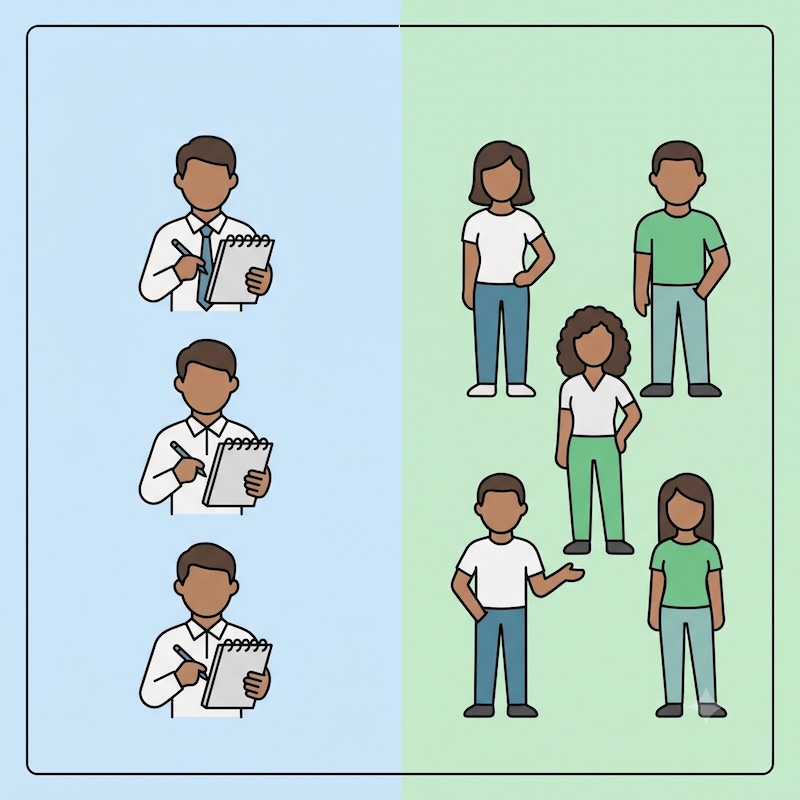
The IT director compares three vendors, arranges demos, gathers internal approvals, and signs the contract. His path from the first Google search to the signature is the customer journey. He asks himself: Which vendor fits strategically? How high is the risk? Is the price-performance ratio right?
The administrator opens the software on Monday morning, struggles with the configuration, looks for a function she needs every day, and files a support ticket because the export doesn't work. Her experience from login to the end of the day is the user journey. She asks herself: Where do I find this setting? Why does this take so long? Why doesn't the export work?
Two people. The same product. Completely different goals, emotions, and success criteria.
The practical consequence: whoever optimizes only the buyer's customer journey overlooks the daily friction points of the people using the product. The result is low adoption, rising support costs, and in the end a cancellation the buyer never saw coming.
From our practice: on a B2B marketplace that was already live, we found exactly this kind of blind spot. Users sent off a request and then received no signal, no confirmation, no hint that anything had arrived. For the person who had decided on the purchase, the journey had long been a success. For the people working with the product every day, it stopped at a wall.
How differently UX works in both worlds overall is explored in our comparison of B2B and B2C UX design.

When you need which map
A simple rule of thumb: if the question is "How do we win and keep customers?", you need the customer journey. If the question is "How does someone experience our product?", you need the user journey.
In practice, the two never exclude each other. The customer journey identifies the critical product touchpoint, for example the onboarding right after purchase. The user journey zooms into exactly that moment and examines what happens there: Which steps are unclear? Where does frustration arise? Where do users drop off? What really happens during onboarding is then revealed by usability testing.
The recommendation: start with the customer journey to set strategic priorities. Then create user journey maps for the moments with the greatest impact on satisfaction and retention. The relevant Customer Journey Touchpoints help you identify those moments systematically.
If you want to set up and interlock both maps in a structured, methodical way, brightside Studio offers support with User Journey Mapping for digital products.
Takeaway: one rule that sticks
The customer journey belongs to marketing. The user journey belongs to product. Together they form a complete picture of the customer experience. Setting up both maps cleanly and interlocking them is part of our UX strategy.
Two concrete next steps:
- In your next team meeting, clarify which map belongs to which team, and which questions each should answer.
- Read the User Journey Mapping Guide before you build your first map.