June 2, 2026
Updated on
August 31, 2026
Critique Workshops: Ensuring UX Quality & Structuring Feedback
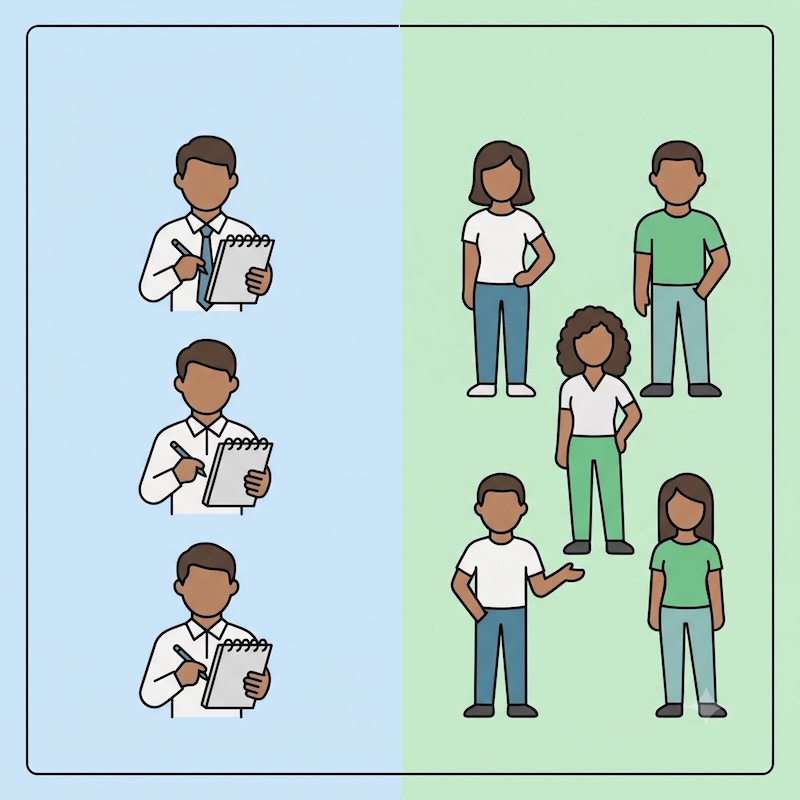
A designer presents a draft. Three colleagues say "Looks good," the team lead wants to change the color, and in the end, you spend twenty minutes discussing a button radius. The actual user problem? Never addressed.



Table of contents
Critique Workshops transform unstructured feedback into a systematic evaluation that measures design decisions against what truly matters: user goals.
This article is the fifth and final part of our series on the most important UX workshop formats. After Discovery, Empathy, Design Studio and Prioritization , the Critique Workshop completes the cycle. It ensures that what has been conceived and prioritized actually works for the user.
What to expect: A clear definition of what a Critique Workshop is, when to use it, how it proceeds step-by-step, and which mistakes reliably ruin it.
In a nutshell: The essentials at a glance
A Critique Workshop is a structured process that anchors design decisions to defined criteria such as user goals, UX heuristics, and business requirements. In it, a multidisciplinary team gathers to evaluate a design based on pre-agreed guiding questions. It's therefore not about "I like it" or "I don't like it", but about questions like "Does this design solve the user's pain point X?"
The timing for its application is at critical milestones: before user tests, before development starts, after prototype iterations. In other words, whenever a design decision needs to be re-validated before it becomes expensive.
What defines a Critique Workshop
The core of the format is the criteria. They can consist of user goals ("What does Sarah need to complete the checkout?"), recognized heuristics (consistency, error prevention, visibility of system status), or specific business requirements ("Registration must be completable in under 90 seconds"). Without these criteria, the Critique Workshop lacks its central focus.
Nielsen's ten UX heuristics work particularly well as a ready-made criteria set.
The distinction from a Design Review
Simply put: Design Reviews are often approval processes. Hierarchy decides.
Critique Workshops are improvement processes. Arguments decide.
In a review, the question asked is: "Are we happy with it?"
In the Critique, the team asks: "Does this solve the user's task based on our defined criteria?"
Both formats have their place, but should never be mixed.
Distinguishing from Usability Tests
Critique Workshops are no substitute for real user tests. Full stop. While incorporating diverse internal perspectives ensures the session addresses the concerns and primary goals of various process facets, internal perspectives remain just that: internal. A Critique Workshop identifies potential issues from an expert's viewpoint. Only testing can reveal whether actual users are truly disappointed or delighted.
The Context in the UX Workshop Hub
Compared to the other formats in this series, the Critique Workshop has an evaluative function. The Discovery Workshop decides what gets built. The Empathy Workshop asks who it's built for. The Design Studio Workshop generates answers. The Prioritization Workshop sorts them. And the Critique Workshop ultimately verifies whether the chosen solution works for users.
When to use Critique Workshops
There are typical times to conduct Critique Workshops along a design timeline. Three stand out:
- At the beginning of a project - When initial design directions are established, but nothing is set in stone yet. Here, the Critique Workshop checks whether the chosen direction aligns with the user goals from the discovery phase. Early feedback is cheap feedback.
- At iteration milestones - When prototypes are available and the team has reached an interim status. You can use a Critique Workshop as part of a new project kickoff or as part of an iteration if you work in sprint cycles.
- Just before development begins - As a final QA gate before code is written. According to the Systems Sciences Institute at IBM, it costs six times more to fix an error during implementation than one identified in the design phase. A Critique Workshop before dev-start is one of the most cost-effective quality measures available.
Important nuance: Critique Workshops work at every fidelity level. From hand-drawn sketches to clickable hi-fi prototypes. The structure is always the same; only the type of feedback changes: for sketches, it's about information architecture and user flows, while for prototypes, it's about interaction patterns and micro-interactions.
How a Critique Workshop works
This section is the core. Here, things get concrete, step-by-step, and immediately applicable.
Preparation: Without context, no actionable feedback
The quality of a Critique Workshop is determined before it even begins. The designer should schedule it when feedback is needed to validate design decisions or overcome specific obstacles. It must also be clear what will be presented.
Define the feedback focus
The presenting designers determine beforehand: What do we want feedback on? This sounds simple but is the most crucial step in practice. For example:
"We are looking for feedback on the navigation structure. Please withhold feedback on colors, typography, or copy."
Without this focus, everyone comments on everything.
Share Personas and Scenarios
When presenting your work in a critique, remember to reiterate the project goals. Briefly summarize the personas, current pain points, user tasks, or previous work. If not all participants share the same understanding of the user, the workshop will generate feedback that pulls in different directions. Send out relevant documents at least one day in advance so everyone can prepare.
Choose Fidelity Deliberately
If possible, present designs in lower fidelity (grayscale) to force focus on layout and flow. Grayscale wireframes are suitable for structural feedback. Clickable prototypes are useful for interaction feedback. Why this is so important: Visual details are distracting. Visual details are highly salient and easy to grasp; this is a phenomenon known as Parkinson's Law of Triviality. High-level UX architecture requires deep cognitive effort, which is why people naturally tend to criticize superficial visuals.
Teams that build on a design system can spend the critique on structure instead of on individual components.
The Workshop Itself: Structure Prevents Chaos
A typical critique workshop lasts 45 to 60 minutes and follows a fixed agenda:
- Context Setting by Presenters (5 - 10 Minutes): Reiterate project goals, briefly summarize personas and scenarios, and define the feedback focus. Avoid lengthy justifications of decisions.
- Silent Feedback (10 - 15 Minutes); Each participant notes feedback on stickies (physical) or in a digital tool (Miro, FigJam). Silent work is crucial because it prevents the first spoken opinion from influencing all others.
- Moderated Discussion (20 - 30 Minutes): The collected feedback is discussed according to the agreed-upon criteria. Not all at once, but clustered thematically. The question is always: Does this design element support or hinder the user in their task?
- Documentation of Action Items (5 - 10 Minutes): Document concrete next steps, assign responsibilities. No workshop without documented outcomes.
Two proven moderation approaches:
There are two main approaches to moderating UX critiques: Round Robin & the Quota Method
- Round Robin: Everyone takes turns sharing their most important feedback. Pro: Everyone gets a chance to speak, even the quieter ones. Con: Can drag on and become repetitive in larger groups.
- Quota Method: Each participant provides a set number of positive and critical points (e.g., 2 positive, 2 critical). Pro: Forces balanced feedback and also forces recognition of what works. Con: Can feel artificial if the quotas don't align with the design.
Require specific feedback language
This is the crucial lever. Instead of "I think the button is too small" the phrasing is:
"I believe the user would overlook the button at this size on a mobile device because it gets lost in the scroll flow."
The shift from "I think" to "The user would" transforms subjective opinion into a user-based argument. When feedback takes the form of "I don't like this" or "That feels strange" without reference to users, task success, or evidence, objective criteria are lacking, and reviewers resort to emotional reactions and personal aesthetic preferences.
The Role of the Moderator
The moderator has a clear task: to ensure the structure is maintained and hierarchy does not dominate the discussion. If the meeting serves less to improve the design and more to demonstrate authority or signal who has the final say, then feedback from senior members carries more weight due to rank rather than relevance. Good moderation means the loudest voice does not win in a critique workshop.
Participants and Tools
Who should attend?
- UX/UI Designers (1-2 as presenters, 1 as moderator)
- Product Manager (brings in the business perspective)
- Engineers (assess technical feasibility)
- Optional: UX Writer, Business Analyst
Too many participants ruin the critique. It's best to limit the number to a maximum of 8 people, as larger groups quickly become unwieldy. 5 to 8 people is the guideline. Better small and focused than large and diffuse.
Tools: On-site, a whiteboard and stickies are sufficient. Remotely, Figma, Miro, or Mural work perfectly. The tool is secondary. The structure is crucial. A perfectly set up Miro board won't save a workshop that lacks a feedback focus.
The 5 Most Common Mistakes in Critique Workshops
Critique workshops sound simple in theory, but in practice, they surprisingly often fail at the same points. Here are the five mistakes we see repeatedly.
Mistake 1: No agreed feedback focus
The team comments on everything: colors, copy, spacing, information architecture, all mixed up. The result is a jumble of disconnected feedback that no one can meaningfully prioritize.
Solution: Before the workshop, define a clear scope. Communicate it in writing - in the invitation, on the first slide, on the whiteboard. "Today, we're focusing on the navigation structure. We'll park everything else."
Mistake 2: Subjective criticism instead of user perspective
"I don't like the shade of green."
"That feels a bit off."
"Can't we make that bigger?"
Such statements sound like feedback, but they aren't. At least not actionable. It's easier to express a preference than to explain why something helps or harms the user. The critique devolves into an unsolvable debate about personal tastes.
Solution: Eliminate "I think" and "I like" from your vocabulary. Replace it with "The user would probably..." or "Based on our persona..." Print the phrasing on a poster and hang it on the wall. No joke.
For copy questions, a separate round pays off: microcopy is one of the most effective UX quick wins there is.
Mistake 3: Hierarchy dominates the discussion
If the CPO speaks first, the rest of the room automatically aligns with their view...or the junior designer doesn't even dare to contribute.
Solution: Consistently separate critique from sign-off and make it clear: No decisions are made in this workshop; instead, perspectives are gathered. The silent feedback phase at the beginning is invaluable here because it allows everyone to form their own assessment before group dynamics take over.
Mistake 4: Solutionizing instead of problem diagnosis
Critiques are not the best opportunity for problem-solving. It's often better to collect feedback, review it, and then think about solutions, rather than trying both simultaneously.
Solution: First, describe the problem ("The user doesn't understand where they are in the process at this point"), then (and only then) outline potential solutions. The facilitator should firmly interrupt anyone who jumps straight to solutions.
Mistake 5: No Follow-up
The most common mistake across all workshops: No one documents anything, no one follows up on the results, and three weeks later, no one remembers the outcomes.
Solution: Always reserve the last 5-10 minutes for documented next steps. Who does what by when? After the critique, it's useful to share the collected feedback with all participants and give everyone the opportunity to add further feedback. Sharing also shows that feedback is being captured and provides an opportunity to communicate and delegate follow-up actions.
Critique Workshops as part of your UX process
Critique Workshops come at the end of this article series, but they are not an endpoint. In every project there are several moments where a structured critique makes sense: after the first wireframe, after a prototype iteration, before the dev handoff.
Their real strength shows in combination with the other formats. A Discovery Workshop defines the goal. An Empathy Workshop builds understanding of the user. A Design Studio Workshop generates solution ideas. A Prioritization Workshop sorts them by impact and feasibility. And the Critique Workshop ensures that the chosen solution truly meets the user's goal.
All five together form a complete quality cycle. None of these formats stands alone, and none makes the others redundant. The overview page on the five most important UX workshop formats shows the interplay in detail.
Conclusion: Feedback that truly makes a difference
Critique Workshops do not replace usability testing with real users. But they are the most effective method to internally ensure that design decisions are tied to real user goals and not just opinions.
The cost of fixing a problem increases exponentially the further the software progresses in the development cycle. A well-moderated Critique Workshop before development starts is therefore one of the most cost-effective quality measures available and can prevent weeks of rework in development.
Critique Workshop FAQ
What is the difference between a Critique Workshop and a Design Review?
A Design Review is often an approval process: the hierarchy decides whether a design should be pursued. A Critique Workshop is an improvement process: the team evaluates a design based on agreed-upon criteria – user goals, heuristics, business requirements – and provides constructive feedback for further development. The key difference lies in the mindset: arguments over rank. You can find more on this in the section "What a Critique Workshop really is – and what it isn't" above.
Who should participate in a Critique Workshop?
Multidisciplinary, but intentionally small: UX/UI Designers (as presenter and facilitator), Product Managers, and Engineers form the core. Optionally, UX Writers or Business Analysts may join. 5 to 8 people is the ideal number – large enough for diverse perspectives, small enough for focused discussions.
In which design phase does a Critique Workshop make the most sense?
Critique Workshops work in every phase – from early sketches to the final prototype. They are particularly effective before user tests (to identify obvious problems beforehand) and before development starts (as a final quality gate). The table in the section "When Critique Workshops are Used" categorizes all five workshop formats along the design process.
How do you prevent feedback in a Critique Workshop from remaining subjective?
Three ways: First, define the feedback focus beforehand ("Today we are only evaluating the navigation structure"). Second, encourage user-centric language – "The user would probably..." instead of "I don't like that." Third, start with a silent feedback phase so that everyone forms their assessment independently before the group discussion begins. A practical tip: Print the feedback formula on a poster and hang it visibly in the room.
How does the Critique Workshop relate to the other UX workshop formats?
The five formats form a cycle: Discovery clarifies the goal, Empathy builds user understanding, Design Studio generates ideas, Prioritization sorts them, and the Critique Workshop checks if the chosen solution truly meets the user's goal. None of these formats stand alone. You can find the complete overview on the hub page for the most important UX workshop formats.